One in four EVs sold in Europe this year will be made in China – analysis
In the short run, tariffs can help EU carmakers – but they need to ramp up electrification to survive.
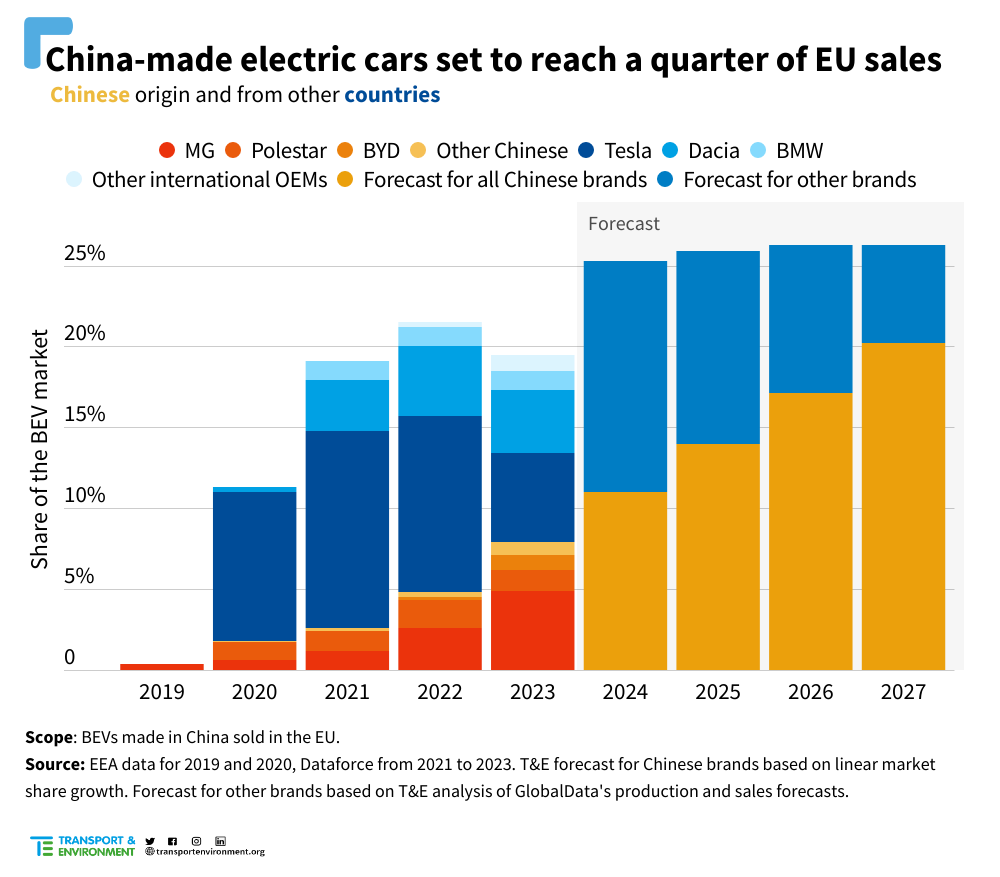
Almost a fifth (19.5%) of electric vehicles sold in Europe last year were made in China and this is on track to reach a quarter (25%) in 2024, according to new analysis by Transport & Environment (T&E). The forecast comes as the EU is considering import tariffs to counter subsidies for China’s EV industry. T&E said ramping up production of mass-market electric cars and investing in the European battery supply chain is the only way for EU carmakers to compete with Chinese brands, but tariffs would also help localise EV manufacturing.
While Chinese imports into Europe have largely been Tesla, Dacia and BMW cars produced there, T&E projects that Chinese brands could reach 11% of the European EV market in 2024 and 20% in 2027. The conservative projection assumes a linear growth in Chinese OEM market share based on the last two years, though BYD alone is targeting 5% of the European electric car market by 2025.
Julia Poliscanova, senior director for vehicles and emobility supply chains at T&E, said: “Tariffs will force carmakers to localise EV production in Europe, and that’s a good thing because we want these jobs and skills. But tariffs won’t shield legacy carmakers for long. Chinese companies will build factories in Europe and when that happens our car industry needs to be ready.”
Raising the EU tariff on all vehicle imports from China to 25% would make medium-sized sedans and SUVs more expensive than their European equivalents – making the case for EU manufacturing, the T&E analysis finds. Compact SUVs and larger cars imported from China are expected to remain slightly cheaper with such a tariff.
However, the EU should not aim to shield its carmakers from meaningful competition, which would limit the offer of affordable electric cars for Europeans, T&E said. It is crucial that a higher tariff is accompanied by a regulatory push to increase production of EVs, including electrification targets for company car fleets by 2030 – on top of the agreed 100% clean car goal in 2035.

But investments in lithium-ion batteries are also at risk as cells manufactured in China are at least 20% cheaper than in Europe, and Chinese battery-makers are ahead on technology and supply chains. The US is also attracting battery investments through generous subsidies. T&E said industrial measures – such as subsidies for clean and circular manufacturing and “Made in EU” targets – are needed to create a pull for local cell production. As neither of these are currently in place, tariffs for battery cells should be considered. Compared to the US and China, the EU currently has the lowest battery cell tariffs.
Julia Poliscanova said: “Batteries are the new solar. China is ahead and its state backed companies have huge overcapacity. If we are serious about a diverse and resilient battery supply chain in Europe, we need to put our money where our mouth is right now. We’re not going to get a second chance.”
Read more:
Report: How Europe can use tariffs as part of an industrial strategy
Related Articles
View All
Drive forward or turn back? Four reasons to vote for a strong automotive package
The coming weeks will be crucial for the future of the EU's car and van CO₂ standards and Clean Corporate Vehicles Regulation — a choice that will sha...

The zombie engine: How Brussels bureaucrats are breathing false life into combustion
If you poured rapeseed oil into a combustion engine and declared it a "zero-emission vehicle," you would be laughed at. But in the EU Parliament, this...

What Europe can learn from China if it wants to save its industry
Something I learned from my trip to China: you can be fast followers if you're willing to learn from the best.