
Ever-bigger? Car size at a crossroads
The impacts on safety, space and resource use if carspreading continues to go unchecked.
Author
Downloads
Executive summary
‘Carspreading’: cars continue to grow in size
The average size of newly-sold cars keeps increasing every year. New T&E and Clean Cities analysis shows that:
-
The average length of new cars keeps increasing by 1.2 cm a year
-
Their average height keeps rising by 0.5 cm a year
These new findings complement previous work showing that new cars keep getting 0.5 cm wider every year (2024), and that bonnet height keeps increasing by 0.5 cm every year (2025).
Car size at a crossroads: the current ever-bigger trend v. vehicle right-sizing
This study compares two scenarios for car dimensions over the period 2026 to 2040. Under the prevailing ever-bigger trend (‘Current trend’), the average size of new cars continues to increase in line with trends since 2000. Under a more balanced scenario (‘Right-sizing’), the average size of new cars steadily returns to 2015 levels. Key findings for the period 2026-2040:
-
Parking: Cities are set to lose 8.5% - 14% of their end-to-end on-street parking spaces by 2040 if the current ever-bigger trend prevails
-
Safety: There are around 2,600 additional deaths of vulnerable road users by following the current ever-bigger trend, including 79 children. (By 2040, the increase in deaths of children walking widens to 40%.)
-
Electricity: By 2040, the current trend would require an additional 22.5 TWh a year, comparable to 1,500 more onshore wind turbines (compared to Right-sizing), increasing annual household charging bills by €7 billion
Part 1
25 years of increasing car size
Size of new cars has increased steadily for more than two decades
While family size and car occupancy decrease, the size of new passenger cars continues to increase across all key dimensions. Vehicle dimension data since 2000 shows that:
-
The average length of newly-sold cars is increasing by 1.2 cm a year.
-
Total vehicle height is increasing by 0.5 cm a year.
-
Vehicle width grew by an average of 0.5 cm per year (T&E, 2024).
-
Bonnet height is rising by 0.5 cm per year since 2010 (T&E, 2025).
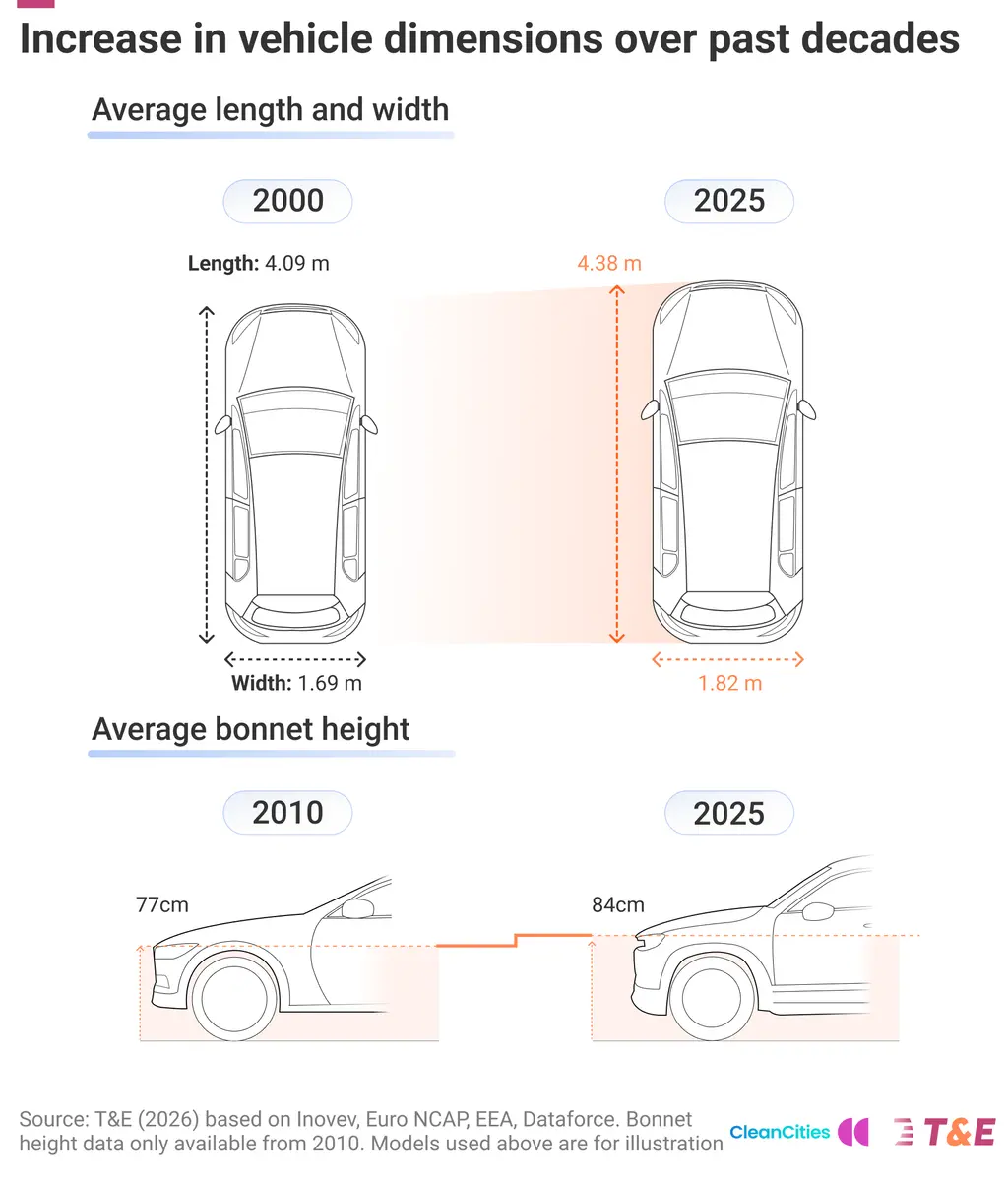
All other things being equal, ever-bigger cars increase road safety risks, take up more space, heighten resource use, and increase running costs.
Part 2
Car size at a crossroads
Two futures for car dimensions: Current trend v. Right-sizing
Carmakers can pursue two very different pathways over the coming 15 years, 2026 to 2040. To illustrate this, the report compares:
-
A continuation of current trends: lack of policies leads to a further growth in big cars. As a result, average vehicle dimension grow linearly. This is modelled by higher shares for C, D, and E-segment vehicles, and increased SUVisation across all segments.
-
Against a right-sizing scenario: policies and incentives support smaller models (with increases in A- and B-segment cars, and a reduced share of SUVs). Average vehicle dimensions taper back to 2010-2015 levels by 2040.

Part 3
Analysis of impacts: Current trend v. Right-sizing
Cities set to lose 8.5% to 14% of their on-street parking spaces by 2040 if the current trend to ever-bigger cars continues
Longer and wider cars occupy more public space. We analyse the impact for end-to-end on-street parking:
-
As average car length increases, the number of cars that fit decreases, reducing on-street parking spaces by 8.5% to 14%.
-
This range partly depends on the profile of the street section, together with assumptions around the willingness of drivers to manoeuvre cars into tight (and highly constrained) spaces.

-
Right sizing is key to protecting urban space. If right-sizing is embraced, the average size of new cars entering the fleet is comparable to that of (older) cars being retired.
-
Right-sizing is vital for cities just to ‘stand still’ in terms of space allocation. It ensures a relatively stable average car length across the fleet as a whole.
-
Without action to tackle the ever-bigger trend, the loss of parking could translate into support to convert other urban space to parking, potentially reducing space available for pedestrians, cycling, nature and other public uses.
Right-sizing is needed to protect urban space


Yearly deaths of children widen to 40% higher by 2040 under current trends
Larger vehicles present increased risks to road safety for vulnerable road users, particularly children walking.
-
Under current trends, 40% more children walking would be killed a year in car crashes by 2040 compared to the Right-sizing scenario (EU and UK). The gap rises through the 2030s, and in 2040, the ever-bigger trend would see 39 children (aged up to 14) killed, compared to 28 under a right-sizing scenario.
-
For vulnerable road users (pedestrians, cyclists, motorcyclists and moped riders of all age groups) current trends would bring 400 additional deaths annually by 2040 compared to a more balanced scenario (14% higher).


How bigger cars lead to more road deaths (methodology)
Higher bonnets increase risk of VRU fatalities:
-
The 2023 VIAS study linked a 10 cm increase in bonnet height to a 27% higher risk of VRU fatalities in crashes.
-
Under the Right-sizing scenario, fleet average bonnet height has moderated to 80.6 cm by 2040, and the application of the VIAS finding implies that approx 1.42% of VRU crashes would result in a fatality.
-
If current trends continue, however, fleet average bonnet height would rise to 86.2 cm by 2040, with 1.63% of VRU collisions resulting in a fatality.
-
The difference in deaths over the period is 2,570 (including 400 in the year 2040).
Higher bonnets have a more pronounced impact on child fatalities:
-
Higher bonnets impose graver risks on children. In the apparent absence of European data quantifying these more severe impacts on children, this study takes US research (Tyndall, 2024) as being the best currently available. It links a 10 cm bonnet height increase to an 81% increase in fatality risk for child pedestrians
-
By 2040, fleet average bonnet height of 86.2 cm under current trends is linked to a 0.67% risk of death for children walking hit by cars. This is markedly above the comparable risk of 0.48% under the right sizing scenario where fleet average bonnet height has moderated to 80.6 cm
-
The difference in deaths over the period is 79 (including 11 in the year 2040).
Ever-bigger cars use more energy, piling pressure on power grids
Larger cars need more energy. Additional electricity generation is required for EVs, with families locked into higher costs:
-
A continuation of the current trend to ever-bigger cars would require more electricity compared to Right-sizing;
-
By 2040, Europe (EU & UK) would need an additional 1,500 wind turbines (averaging 5 MW each) to serve a 22.5 TWh gap between Current trends and Right-sizing (see right);
-
There would be a rising burden on European electricity grids, many of which are already stretched;
-
Cumulatively, the additional electricity required to 2040 is 116 TWh without changes to current trends. This additional power requirement adds €36 billion to household recharging bills across the EU and UK over the period 2026 to 2040 (€7 bn in 2040 alone).

Bigger cars would cost Europe >100m additional barrels of imported oil
Bigger cars mean higher oil dependence as combustion cars continue to dominate the fleet in the period 2026 to 2040:
-
If current trends continue, an additional 100 million barrels of oil imports would be needed by 2040;
-
If the car CO2 law is weakened further, an additional 140 million barrels of oil imports would be needed. Based on average 2021-25 oil prices, this would translate into nearly €10 billion;
-
This is roughly equivalent to Germany’s total oil import bill for its entire passenger car fleet in 2025.

Conclusion
Ever bigger cars: where does it stop?
Relentless carspreading highlights critical questions for Europe: where does it stop? When does it stop? If left unchecked, the average new car by 2040 will balloon to an estimated 4.56 meters long and 1.90 meters wide, up from 4.09 meters by 1.69 meters in 2000. This trajectory is deeply regressive, compromising public safety, eroding urban space, and inflating household energy bills.
It is entirely possible to bend this curve and transition to a balanced, right-sized vehicle fleet, but doing so requires swift and decisive political action. The evidence is undeniable. Now is the time to protect public safety, shared space, and Europeans under pressure from ever-bigger bills.
To succeed, policymakers must deliver a coordinated, multi-level response. The EU must establish meaningful dimensional limits that end the mimicking of US-style mega-SUVs, and their importation. At the same time, national governments need to reform registration and circulation taxes to disincentivise oversized vehicles, while local authorities must deploy fairer, size-focused parking charges to safeguard public space.
If policymakers don’t take action to curb the ever bigger trend, the regressive impacts will continue to increase.
Policy action to curb ever-bigger cars:
-
1
Cap bonnet height in new cars at 85 cm, and limit width to 192 cm (EU level, and UK)
-
2
Add vehicle dimensions to vehicle registration certificates (national governments / EU)
-
3
Ensure that regulatory advantages only go to small electric cars (not longer than 4.2 metres) in revising car CO2 law (EU)
-
4
Rate the vision of children from the driver’s seat of new cars (Euro NCAP), and apply a Child Vision Standard in law (EU, and UK)
-
5
Vary car taxes and parking charges by dimensions (national governments, and cities)
Related Articles
View All
Briefing
The EU Clean Corporate Vehicles Regulation: the industrial and economic benefits of “Made-in-EU” electric company cars
New independent modelling by Fraunhofer ISI shows that implementation of the Clean Corporate Vehicles Regulation could deliver up to €48bn in value cr...
Press Release
Rapid transition to electric company cars could generate 344,000 EU jobs by 2030 - study
Setting targets on companies to go electric and limiting financial support only for company cars that are electric and Made-in-EU would see economic g...

Press Release
Franco-German car deal a ‘historic mistake’ that weakens climate ambition and Europe’s car industry
Deal to loosen the EU’s car CO₂ standards and IAA requirements a ‘historic mistake’ that puts Europe’s position in the global EV and battery race in j...