
EV progress report: 'Don't stop me now', the EV transition is delivering
The EU car CO₂ targets are delivering record electric car sales and a wave of affordable models. However, weakening the 2030-2035 target as currently discussed in the car CO2 negotiations would halt the ramp-up of small affordable EVs and compromise European carmakers’ ability to compete in the global EV race.
Authors


Downloads

Key findings:
-
Electric car sales hit record highs in 2026. 1.64 million BEVs were sold from January to August, 45% more than a year earlier, and BEVs outsold petrol cars for the first time over a full quarter in Q2 2026.
-
The regulation is bringing affordable models to market. About 60 new models are expected by the end of 2026, a record. This is nearly 4 times the average 15 new models per year (period 2021-2025), with choice for affordable models below €25k set to double in 2026 alone.
-
Sales of cars priced below €25,000 are set to increase by a factor of 7 compared to 2024.
-
Carmakers have already closed 75% of the gap to their 2025–2027 CO₂ target, halfway through the period. All European carmakers are expected to comply, with many carmakers meeting their obligations ahead of schedule.
-
Carmakers say electric cars will match combustion profits by the end of the decade. Margin parity comes from the scale delivered by the car CO2 target requirements.
-
Weakening the 2030 target would halt the ramp up of affordable BEVs. Under the EPP/Salini proposal, BEVs would stall at 22% of the market in 2030 instead of 47%, with sales of models below €25,000 cut by nearly three quarters, and cumulative emissions to 2050 would be 40% higher than under current law.
-
Upholding the 2030-2035 targets would keep European carmakers in the global EV race. Under the current regulation, European carmakers’ global BEV sales could close the gap with Chinese carmakers by 2035. Conversely, the EPP/Salini proposal would cut EU carmaker BEV sales in half, effectively ceding global leadership to China.
Car CO₂ emissions are barely falling while Europe faces intensifying heatwaves and fire risk
Car emissions remain stuck 18% above their 1990 level as climate-driven extreme events intensify across Europe.
-
Cars emitted more than 450 MtCO₂e in 2025: 43% of EU’s transport sector emissions and 14% of total emissions.
-
New combustion cars (including hybrids) emitted 160 gCO₂/km in real-world driving in 2023, only 10% below the level in 2000.
-
When BEVs are included, the new-car real world CO₂ emission average is around 135 gCO₂/km, 24% below the 2000 level.
-
But progress remains too slow, as it takes time to electrify the car stock (BEVs only made up 3% of the cars on the road in 2025).

Petrol and diesel drivers pay the price of Europe's oil dependency, electric drivers do not
Home-charged electric cars cost 50% less to run than petrol and diesel cars as of 14 September 2026.
-
Diesel has risen most, up 38% since the Iran war began, with a 50-litre tank now costing €30 more. Switching to electric then would have saved around €350 by mid-September.
-
The oil price shock has cost EU road users €53bn, with diesel accounting for €40bn.
-
The oil crisis is pushing buyers towards electric. VW's sales chief attributes rising EV demand partly to high petrol and diesel prices.
-
Electric cars are cutting Europe's oil import bill. Nearly 8 million electric cars in the EU avoided 46 million barrels of oil in 2025, worth €2.9 billion.

Section 1
The EU EV market growth, driven by the car CO2 target compliance
The BEV market in the EU is surging and reaching record highs
BEV sales across the EU are reaching record highs, propelled by the 2025–27 EU car CO2 targets, which are compelling manufacturers to accelerate EV sales.
-
BEVs reached record volumes in 2026. 1.64 million BEVs were sold in the EU in Jan-Aug 2026, a 45% increase y-o-y.
-
The period Jan-Aug 2026 recorded a 22% BEV share. Up 6 percentage points with respect to the same period in 2025. In August, the BEV share reached 28%.
-
BEV sales surpassed pure petrol for the first time over a full quarter (22%) in Q2 2026.
-
European carmakers account for 7 of the 10 best-selling BEV models.

Big markets are accelerating and driving the growth
-
Large markets such as France and Germany, are driving the growth. Together they account for around 50% of the bloc’s BEV sales in the first half of the year, with market shares reaching 38% in France and 32% in Germany in August 2026.
-
Italy and other countries in Eastern Europe recorded a strong growth in BEV sales volumes (e.g. Italy +69%, Slovenia +151%, Bulgaria +103%) but remain in single digits.
-
BEV sales surpassed pure petrol sales in Q2 2026 in 10 countries.

Historic product rollout: BEV models surged to over 150 as of mid 2026
2026 is a pivotal year for BEV availability, with model choice up 50% in a single year as carmakers expand their line-ups to meet CO₂ targets.
-
Model choice is increasing by close to 40 new models launched in the 1st half of the year and 20 expected in the 2nd half of the year (excluding niche offerings).
-
About 60 new models are expected in 2026 which is nearly 4 times the average ~15 new models per year over the period 2021-2025.
-
European carmakers lead with nearly 60% of available models, adding 16 in H1 2026, while Chinese carmakers hold 21% and added 11.

Carmakers representing half of the market have already met their CO₂ targets
Halfway through the 2025–2027 compliance period, carmakers have successfully closed 75% of the gap to their three-year CO₂ target relative to 2024 levels.
-
Half the market has already achieved compliance. BMW, the Mercedes-Volvo pool, Stellantis, Kia and the Tesla-Ford pool are already meeting their targets as of mid 2026. Renault Group is on the verge of compliance (less than 1 gCO2/km gap).
-
Volkswagen currently faces a 7 gCO₂/km compliance gap (see next slide) while Porsche is within 2 gCO₂/km following its pooling with XPeng.
-
All European carmakers are expected to comply by the end of the full 3 year period.

Volkswagen is on track to meet the 2025–2027 target thanks to BEV rollout
Our analysis finds Volkswagen on track to meet its 2025–2027 CO₂ target, reaching a 22% BEV share in 2026 and 26% in 2027.
-
New small BEVs to close the gap: the ID. Polo, Cupra Raval and Škoda Epiq in H2 2026, then the ID.Up by the end of 2027. CEO Blume says these "will put us in a better position to reduce the remaining gap to the CO₂ targets".
-
BEVs reached 31% of VW's European order book in June. The entry-level family has 100,000+ pre-orders, 40,000 for the ID. Polo.
-
VW is shifting German production from ICE to BEV, as BEV demand outpaces its forecasts.
-
Compliance is driven by BEVs, though HEV and efficiency gains are also needed.

Electric cars are reaching profit parity according to carmakers
Carmakers' own statements to investors put electric cars at profit parity with combustion by the end of the decade, and BMW and Volvo Cars say they are already there on their newest models. Price and margin parity comes from scale.
-
New platforms unlock profitability: BMW's Neue Klasse and Volvo's SPA3 are engineered to close the margin gap, while Stellantis' STLA One sets a clear path to cost parity over time.
-
Affordable BEVs can be profitable: Renault makes higher margins on its smallest electric models than on its larger ones, and Stellantis expects its ~€15,000 e-car to reach cost parity with ICEs in 2028.

Section 2
Supply of affordable BEVs
Car CO2 targets are driving sales of affordable EV models
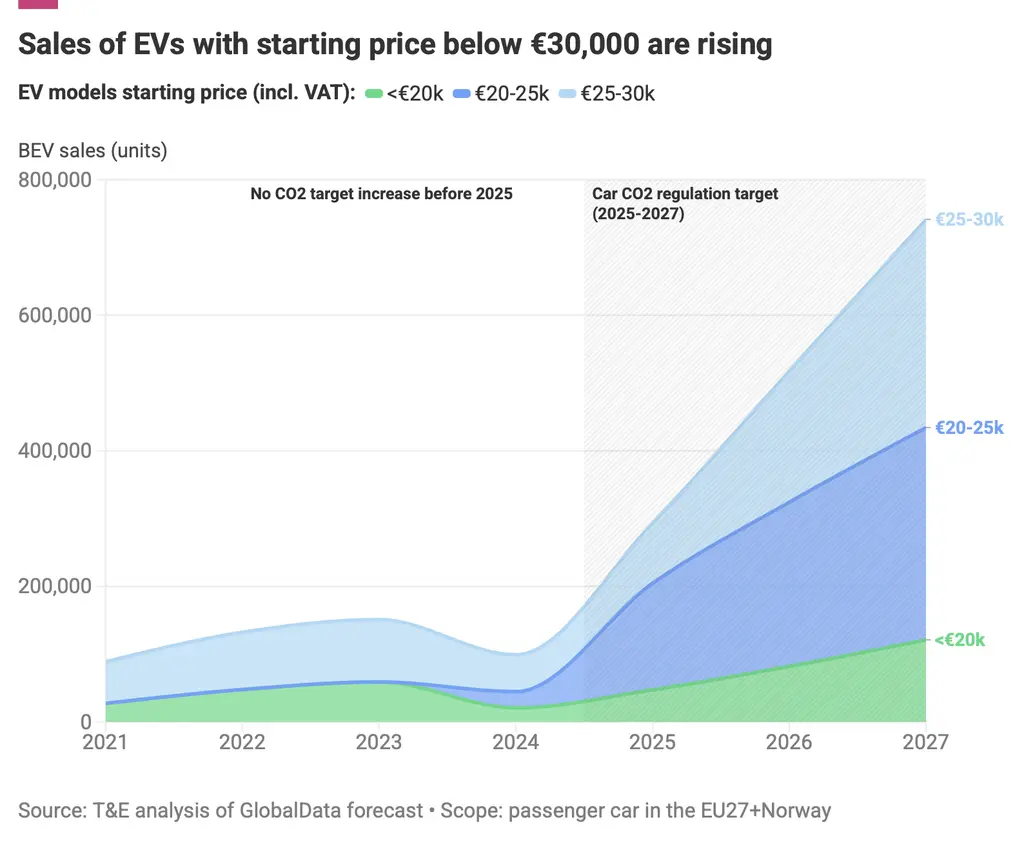
Carmaker electric vehicle offerings are driven by the car CO₂ targets. With flat targets in 2021-2024, manufacturers had limited incentive to introduce affordable models. The current three-year target is now driving a wave of affordable models.
-
Sales of models with a starting price below €25,000 are set to be seven times higher in 2026 than in 2024.
-
They are expected to grow a further 34% in 2027, reaching close to ten times the 2024 level.
-
Models starting below €30,000 are expected to reach close to a quarter of the EV market in 2027.
Availability of affordable BEV models is growing fast
The EV market is now shifting focus from the €25,000 price point toward models in the €20,000 range, with a new generation of segment A vehicles starting as low as €15,000.
-
By the end of 2026, 16 models below €25,000 will be available - a doubling compared to the previous year - of which 4 are below €20,000.
-
Around 10 models at or below €20,000 by 2028. This includes the Renault Twingo, Volkswagen ID.Up and Dacia models.
-
Stellantis E-car family is expected around €15,000, with a Citroën 2CV revival confirmed and a Fiat entry-level Panda reported.
-
Roughly 60% of affordable models available by 2028 are expected to be Made-in-EU.

The current affordable model availability gap with petrol is set to be largely closed by 2028
By 2028, the availability gap in the €20-25k range is set to be closed, assuming ICE offerings remain stable. The gap would be widest below €20k, with 11 BEV models expected in 2028 against 20 ICE models today.
-
24 BEV models are priced below €30k as of H1 2026. 10 of them from European carmakers.
-
More ICE models are available at lower prices today: close to three times as many sub-€30k models, increasing to 4.4 times in the €20–25k range.

Smaller cars below 4.1-4.2m are more affordable
The European Commission has proposed labelling electric vehicles up to 4.2 meters as "small and affordable" (M1E).
-
This classification leverages the correlation between vehicle length and price point (which are both linked to carmakers segments and portfolios).
-
Two vehicles meeting these criteria (the Renault 5 and Leapmotor T03) ranked among the top 10 BEV best-sellers during the first half of 2026.

Section 3
Global shift to BEVs
The race between Chinese and European carmakers and the rise of leapfrogging emerging markets

Several markets are electrifying faster than large blocs like the EU and China
Smaller markets, particularly across the Asia-Pacific region, have outpaced both China and Europe in the adoption of BEV technology.
-
Vietnam has seen the fastest growth. The country went from 5% to more than 40% share in less than 3 years.
-
Australia recorded rapid growth, especially over the last two years.
-
The US lost momentum, its BEV share never crossing 10%.

Emerging markets favour BEV technology over hybrids
Emerging countries, especially across South-East Asia, see a fast shift towards BEV, with a small penetration of hybrid (HEV+PHEV) technology.
-
South-East Asia favours BEV. It displays the fastest transition from ICE to BEV in new registrations
-
Hybrids have the strongest penetration in legacy markets (EU, Japan and South Korea).
-
The US market is still largely dominated by pure ICE sales.

BEV exports from the EU are expected to almost triple in the next 5 years
The next five years will mark a strong increase in BEV production in Europe, driven by the sales targets in the Union. This marks an opportunity for European carmakers to also pivot exports from ICEs to BEVs.
-
BEV export volumes are expected to almost triple in the next 5 years according to market intelligence forecasts: from 0.6 million cars in 2026 to 1.6 million cars in 2031.
-
For reference, today EU carmakers export 3 million cars in total (including all powertrains).

BEV export growth can compensate for the sharp drop in the ICE exports
BEV exports can make up for the sharp fall in ICE demand in other markets.
-
European exports of pure combustion vehicles fell to 0.3 million units in 2026, because of a fast switch towards EVs and hybrids.
-
Hybrid vehicles (HEVs) are now the majority of exported vehicles. These include full HEVs and mild HEVs.
-
BEV export volumes are projected to accelerate significantly in the coming years.


Section 3
Car CO2 review: The make-or-break moment for the European car industry
Analysis of current car CO2 proposals and their implications
The EPP proposal combines every possible weakening factor
The EPP rapporteur Massimiliano Salini has introduced a proposal on the EU's car CO2 standards that exceeds the demands of the auto industry. Instead of pursuing a political compromise, the proposal creates significant loopholes:
-
Scrapping the correction of the utility factor for PHEVs.
-
Averaging the 2030 target over five years.
-
Creating a broad exemption for vehicles running on so-called "eligible fuels" (i.e. biofuels with weak sustainability requirements).
-
For 2035, he proposes a 73% CO2 reduction vs 2021 based on 10% granted unconditionally, 10% ‘eligible’ fuel credits, and 7% from low-carbon steel credits.

The EPP proposal would stop EV growth momentum
Our analysis shows BEV sales could stagnate by 2030 under the EPP/Salini proposal. In the most extreme scenario, carmakers could sell no BEVs at all from 2030 and still remain compliant.
-
Stagnating 22% BEV share in 2030, as opposed to the 47% in the Commission proposal.
-
39% BEV share in 2035, as opposed to the 85% in the Commission proposal.
-
Additional CO2 emissions of 2.8 Gt over 2025-2050, representing a 40% increase compared to the current regulation.
-
The high uncertainty about the pace of the BEV transition under the EPP/Salini proposal would effectively destroy the business case for BEV investments.

Weaker car CO2 targets would hand China undisputed leadership in the global EV race
A weaker car CO2 target in the EU in line with the EPP/Salini proposal will drastically slow down domestic sales of BEVs and thus give up on our chances of competing in the global EV race.
-
Under the EPP/Salini proposal, European OEM BEV sales are expected to be around half of Chinese OEM BEV sales in 2035 (5.7 million vs 11.9 million)
-
If the EU safeguards the current targets, it can catch up with Chinese competition in the global EV race.

Weakening EU electrification targets would deepen oil dependency
The EPP/Salini proposal would lock Europe into oil dependence for decades to come.
-
The proposal would increase oil imports by about 3.5 billion barrels between 2026 and 2050 compared to keeping strong EU vehicle targets with more ambition on corporate fleet electrification.
-
Oil imports would more than double in 2050 compared to the T&E scenario.
-
This is €288 billion in additional oil import expenses by 2050.

Allowing biofuels in new cars threatens the wider transport sector decarbonisation
Aviation and other sectors already need more advanced biofuels than Europe can sustainably produce. Allowing new cars to run on them would stretch that supply past breaking point.
-
Salini's proposal would add 42% to 102% to biofuel demand in 2050. The lower figure is the fuel credit alone; the upper adds cars sold as running exclusively on eligible fuels.
-
Total transport demand would reach 2 to 12 times what can be sustainably sourced, depending on how much waste and residue feedstock is assumed available.
-
The shortfall would be met by imports Europe cannot verify. Fraudulent UCO and POME are already a well-documented problem.

Upholding the 2030 CO2 target could unlock a new wave of small affordable EVs
If the 2030 CO₂ target is maintained, a new class of small, affordable vehicles made in Europe could reach the market from 2028.
-
More than 1 million small BEVs with a starting price below €20k could be sold in 2030, assuming they grow at the same rate as models priced €20–30k did, with a three-year lag.
-
Models with a starting price below €30k could exceed 2 million sales.
-
Under the right conditions, €15k EU-made BEVs have the potential to reach 2.5 million annual EU sales by 2030–2035 (source: FNH & IMT).

Affordable BEV models would be the first victims of weaker targets
Under the EPP/Salini proposal, carmakers would not need to sell any more affordable EVs than the current 2025–2027 period already requires.
-
Sales of affordable EV models priced below €25,000 would be cut by nearly three quarters by 2030 under the Salini proposal, leaving buyers with only larger, more expensive models.
-
The Commission's own proposal would cut them by more than half

Conclusion & policy recommendations
'Don’t stop me now': uphold the targets and Europe stays in the EV race
Halfway through the 2025–2027 compliance period, the evidence is clear: car CO₂ targets are working as intended. Carmakers have already closed 75% of the gap to their three-year targets, and half the market is compliant, disproving earlier industry claims that the goals were unreachable.
The final quarter of 2026 is a make-or-break moment for the European industry. As negotiations on the CO₂ rules conclude, lawmakers must decide whether to secure Europe's electric future or stall the transition with dead-end alternatives like biofuels, effectively handing undisputed global EV leadership to China.
Politicians must act decisively to protect citizens and make this fossil fuel crisis Europe’s last one. We need an immediate reset of the electric car debate to protect European industry and consumers, as demanded in June by a broad coalition of industry groups and civil society.
EV momentum is surging across the continent. Choking off this momentum now only locks Europeans into debilitating oil dependency. When co-legislators vote this autumn, the choice is simple: welcome a cleaner, safer, and more affordable electric era, or force Europeans to keep paying the price of fossil fuel dependency.
Protecting CO₂ standards is key for EU competitiveness, including exports
T&E's policy recommendations:
-
1
Reject the freeze of the utility factor for PHEVs, and stay the course for the correction of the utility factor in order to close the growing real world emission gap.
-
2
Oppose five-year averaging (2028–2032) and remove the three-year averaging in 2030.
-
3
Remove the fuel credit mechanism from 2035 and reject so-called ‘vehicles running exclusively on eligible fuels’ (VEEFs).
-
4
Limit low-carbon steel credits to "Made-in-EU" green (fossil-free) steel.
-
5
Limit super-credits to small BEVs under 4.1 metres with a 1.2 multiplier.
-
6
Add real-world data to car labels, for electric and combustion vehicles alike, alongside the official WLTP value and allow differentiation by vehicle carbon footprint.
Related Articles
View All
Briefing
The EU Clean Corporate Vehicles Regulation: the industrial and economic benefits of “Made-in-EU” electric company cars
New independent modelling by Fraunhofer ISI shows that implementation of the Clean Corporate Vehicles Regulation could deliver up to €48bn in value cr...

Press Release
Rapid transition to electric company cars could generate 344,000 EU jobs by 2030 - study
Setting targets on companies to go electric and limiting financial support only for company cars that are electric and Made-in-EU would see economic g...

Press Release
Franco-German car deal a ‘historic mistake’ that weakens climate ambition and Europe’s car industry
Deal to loosen the EU’s car CO₂ standards and IAA requirements a ‘historic mistake’ that puts Europe’s position in the global EV and battery race in j...