Europe paying €200 million a day diesel premium, report shows
Europe is the world’s most exposed region to high diesel prices with drivers paying an additional €30 at the pump
-
Europe currently paying a €203 million a day premium for diesel as a result of geopolitical disruption;
-
38% of the passenger cars on EU roads are diesels, making Europe the most exposed region in the world to high diesel costs;
-
Drivers paying a premium of €30 at the pump, while trucks paying €236 extra a week;
-
30% of Europe’s diesel fleet is more than 15 years old;
-
If the current diesel premium continues until Christmas, the EU will have spent the equivalent of offering a €2000 scrappage fee for all diesel cars over 15 years old.
Record diesel prices cost Europe an additional €203 million a day[1], a new T&E study shows. With no end to geopolitical disruption in-sight, a faster EV ramp up through scrappage schemes and tighter vehicle emissions rules are urgently needed to shield the continent from prolonged high prices, says T&E.
A tightness in the market for refined oil products means that the gap between already high crude prices and diesel has widened. As a result, refineries are making historical profits, with oil companies doubling their latest quarterly profits in Europe at the expense of consumers.
The EU is uniquely exposed as it is the region most reliant on diesel. Road consumption makes up the vast majority of diesel and gas oil consumption in the EU. As is the case globally, a large chunk of this goes towards transporting goods with truckers now paying more than €236 a week in additional costs. What makes Europe particularly vulnerable is its high rate of car dieselisation, with drivers now forking out an extra €19 every time they fill up their tanks.
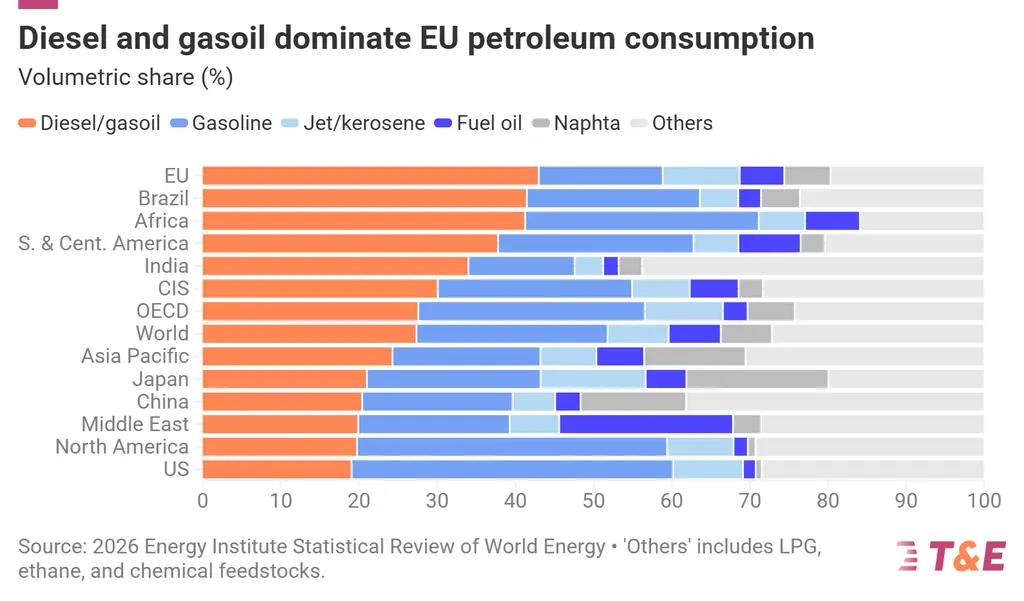
Antony Froggatt, senior director at T&E, said: "Europe’s decades-long strategy of dieselisation is coming back to bite. Higher pump prices are squeezing consumers, while higher transport costs push up the price of everything else. It's a cruel irony that the US is the least vulnerable to a crisis of its own making, while Europe's economy again takes the hit. The solution is clear. Every diesel we replace with an electric is another thousand litres of oil saved.”
Short-term measures, including reducing motorway speeds by 10km/h, eco driving guidance and car sharing could cut diesel demand by 15%[2]. In the longer-term, electrification would significantly reduce diesel demand.
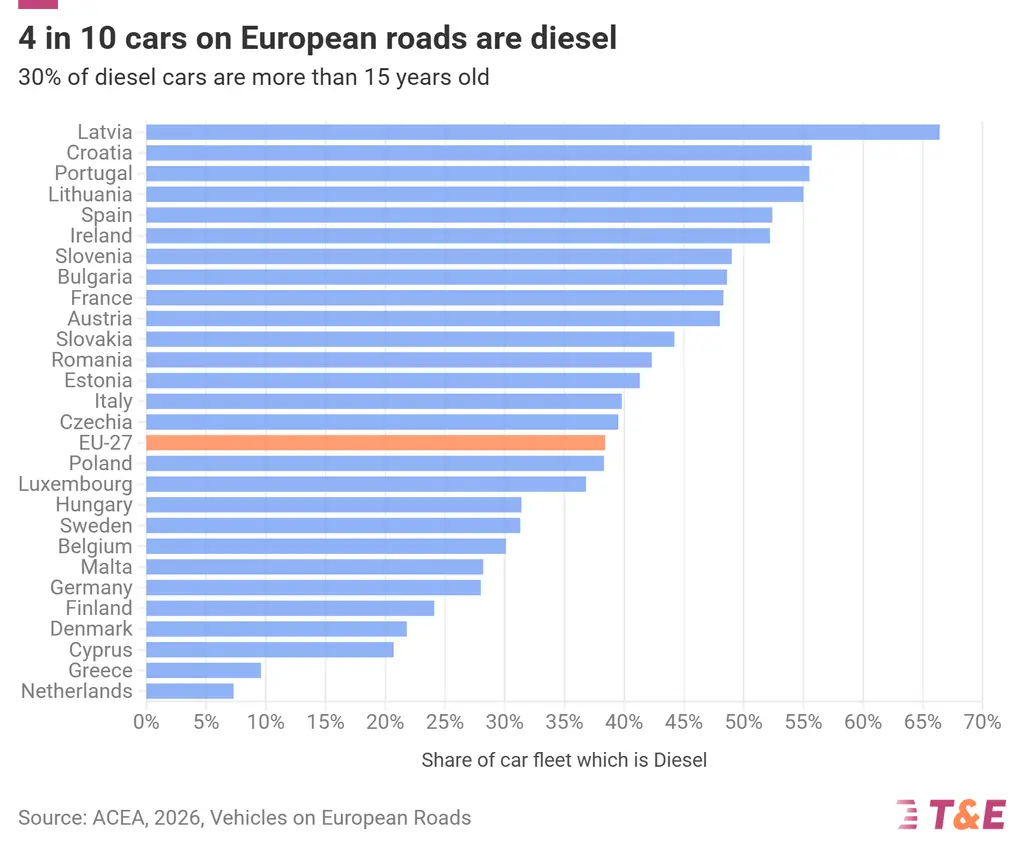
Almost all European countries are painfully exposed to high diesel prices. France alone is home to almost a fifth of all the diesel cars in Europe. With 30% of Europe’s diesel fleet more than 15 years old, government-funded scrappage schemes could take a large chunk of the current diesel car fleet off the road. If the current diesel premium continues until Christmas, the EU will have spent the same as offering a €2000 scrappage fee for all diesel cars over 15 years old.

“Politicians are weighing up fuel duty cuts, which will only extend the pain for longer and shift the burden onto taxpayers. Support should be targeted to low income drivers. The longer the conflict goes on, the more expensive Europe’s diesel premium becomes. Investments in scrappage schemes now will start to pay back quickly,” says Antony Froggatt.
Just eight oil majors have made €7.5 billion in excess profits in the EU in the first half of 2026. “Tax windfall profits and use that to fund electrification,” concludes Froggatt.
ENDS
Note to editors:
[1] On average since the start of the conflict. T&E excludes tax cuts as they do not reduce the real cost: lower taxes at the pump represent lost public revenue that taxpayers must ultimately pay elsewhere.
[2] T&E analysis based on IEA, central scenario
Related Articles
View All
Wave of affordable electric cars is boosting consumers' choice: sales of sub-€25,000 models set to rise sevenfold
Electric car choice is expanding rapidly thanks to EU clean car targets, but weakening the 2030-35 targets would put affordable models and Europe’s po...
EV progress report: 'Don't stop me now', the EV transition is delivering
The EU car CO₂ targets are delivering record electric car sales and a wave of affordable models. However, weakening the 2030-2035 target as currently ...

Unlock public EV charging price transparency and competition
T&E position on the revision of the Alternative Fuels Infrastructure Regulation for Light Duty Vehicles