150 new power plants: the cost of balancing the grid if the EU slashes EV targets
Scaling back the EU’s electric car targets makes the transition to renewables far more expensive to achieve.
Europe’s electricity system could be one of the biggest victims of plans to scale back electric vehicle targets. By providing ‘batteries on wheels’, EVs are set to fundamentally rewire the math of the electricity sector. But fewer electric cars would mean less storage capacity for the grid to absorb excess wind and solar energy and feed back at times of peak electricity demand. To make up the difference, EU countries would have to provide new power generation equivalent to building 150 extra power plants, a new study finds.[1]
In the study for T&E, Fraunhofer ISI assessed the diminished potential of vehicle-to-grid (V2G) technology in the EU if EU targets are weakened. V2G is a technology which allows EVs to push power back into the grid when there is a shortfall. But car industry lobby ACEA has demanded the EU scale back its car CO2 targets, which would result in 49 million fewer EVs on European roads in 2040. The EU Parliament’s lead MEP on the targets has proposed weakening them even further.

Fewer EVs would result in large amounts of excess energy being wasted and reduce the additional deployment of new solar PV by more than a third, the study finds. There would be 37% less new solar PV (-51 GW) installed in the EU between 2025-2040 if EU car CO2 targets are weakened as the car lobby ACEA industry demands.
Geert Decock, electricity and grids manager at T&E, said: “EVs can act like a continent-sized sponge to soak up excess solar and wind energy and feedback into the grid when it’s needed. But the car industry’s demands to weaken EU electric car targets would result in far less EV battery storage being available. That would change the business case for renewables and suffocate solar deployment.”
Without those extra millions of car batteries to soak up excess wind and solar power, Europe would be losing an additional 6 TWh of clean energy a year by 2040, the report finds. That is because wind and solar farms will be disconnected at times of peak generation if there is not enough electricity demand and storage. ACEA’s demands would result in 25% more renewable electricity being curtailed than if the car CO2 targets are maintained.
The grid would have to step in with additional power generation at times of high electricity demand. If there are fewer EVs to feed into the grid, Europe would need one-third more back-up capacity (+13 GW) than if the current car CO2 targets are maintained. That is equivalent to building an additional 150 ‘peaker’ power plants.
Europe would have to spend an extra €4 billion a year upgrading its grid infrastructure if the car CO2 targets are weakened. Thicker cables and more transformers will need to be installed to handle heavier loads as there will be fewer EVs to discharge power locally during demand spikes.
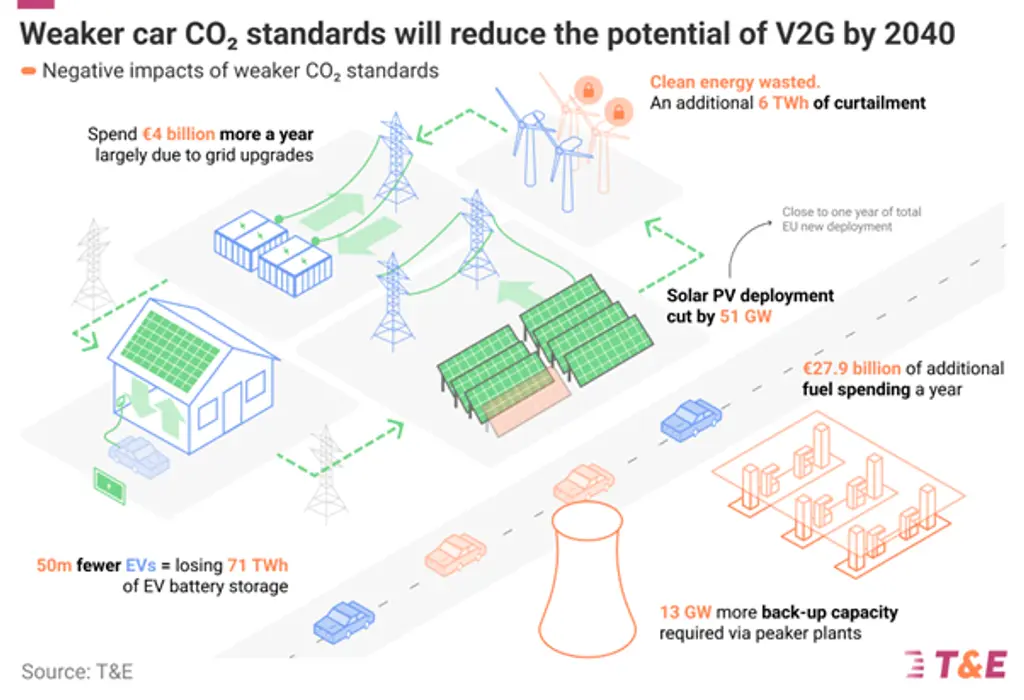
T&E called for the current EU car CO2 standards to be maintained. If the targets are met, electric vehicles would allow the bloc to save €27.9 billion per year on fuel. But while the car CO2 standards will ensure there is a critical mass of EVs available for V2G, regulators must address the fact that today most new electric cars are not compatible with V2G systems. The EU's Automotive Omnibus legislation should require all new EVs to have interoperable and bidirectional onboard chargers from 2032.
Geert Decock said: “High oil prices have made energy security and the transition to renewables more urgent than ever for the EU. But scaling back the bloc’s electric car targets makes that transition far more expensive to achieve. With fewer EV batteries in the system, investors won't finance the solar build out at the same scale and billions more will need to be spent on new power plants, energy storage and upgrades. Maintaining the EU car CO2 standards is key to cleaning up road transport but also to transitioning the energy system.”
Notes to editors:
[1] Using Beyond Fossil Fuel’s ‘Gas Database’, the average capacity of the peaker plants (only considering Open Cycle Gas Turbines that will not be retired before 2040) was 86 MW.
Related Articles
View All
Wave of affordable electric cars is boosting consumers' choice: sales of sub-€25,000 models set to rise sevenfold
Electric car choice is expanding rapidly thanks to EU clean car targets, but weakening the 2030-35 targets would put affordable models and Europe’s po...
EV progress report: 'Don't stop me now', the EV transition is delivering
The EU car CO₂ targets are delivering record electric car sales and a wave of affordable models. However, weakening the 2030-2035 target as currently ...

Unlock public EV charging price transparency and competition
T&E position on the revision of the Alternative Fuels Infrastructure Regulation for Light Duty Vehicles