Weakening CO₂ standards undermines the Vehicle-to-Grid potential of EVs
A new report by Fraunhofer ISI examines the diminished benefits of V2G for Europe's electricity system if the EU weakens its car CO2 targets.
A new study by Fraunhofer ISI for T&E finds that severely weakening the EU’s CO₂ standards will not only undermine the future of Europe’s automotive industry. It will also negatively impact the decarbonisation of the electricity system. If the car industry’s demands are followed, the flexibility potential of EVs and V2G in particular will be reduced. This T&E briefing summarises the study’s findings.
Key findings
-
1
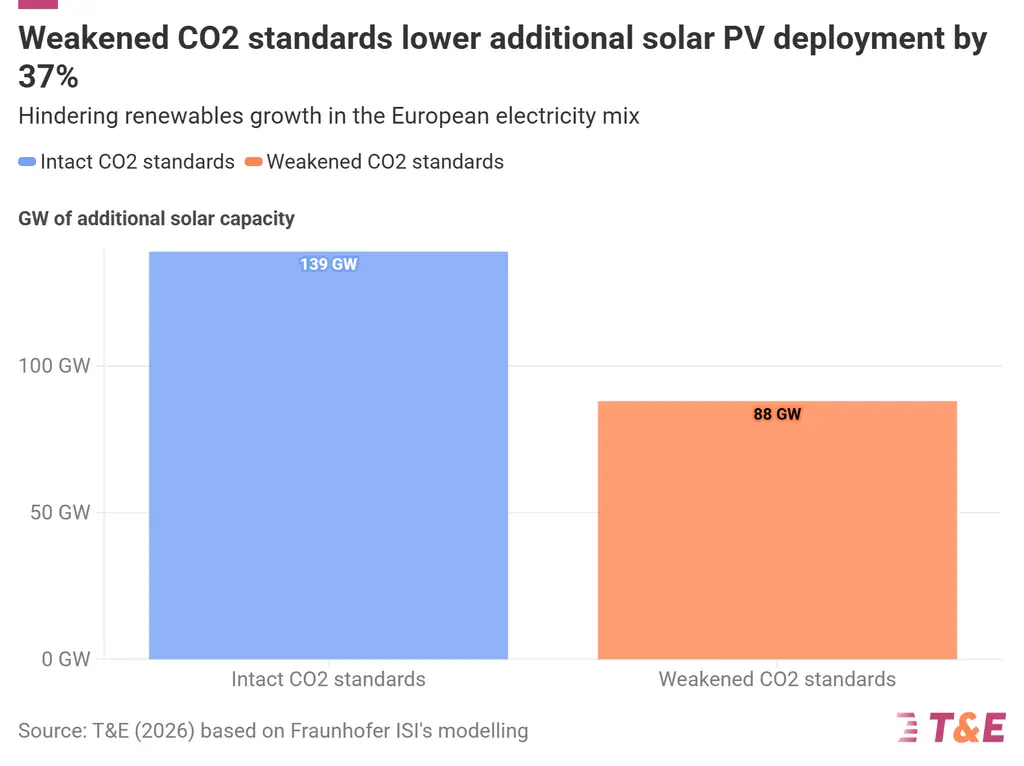
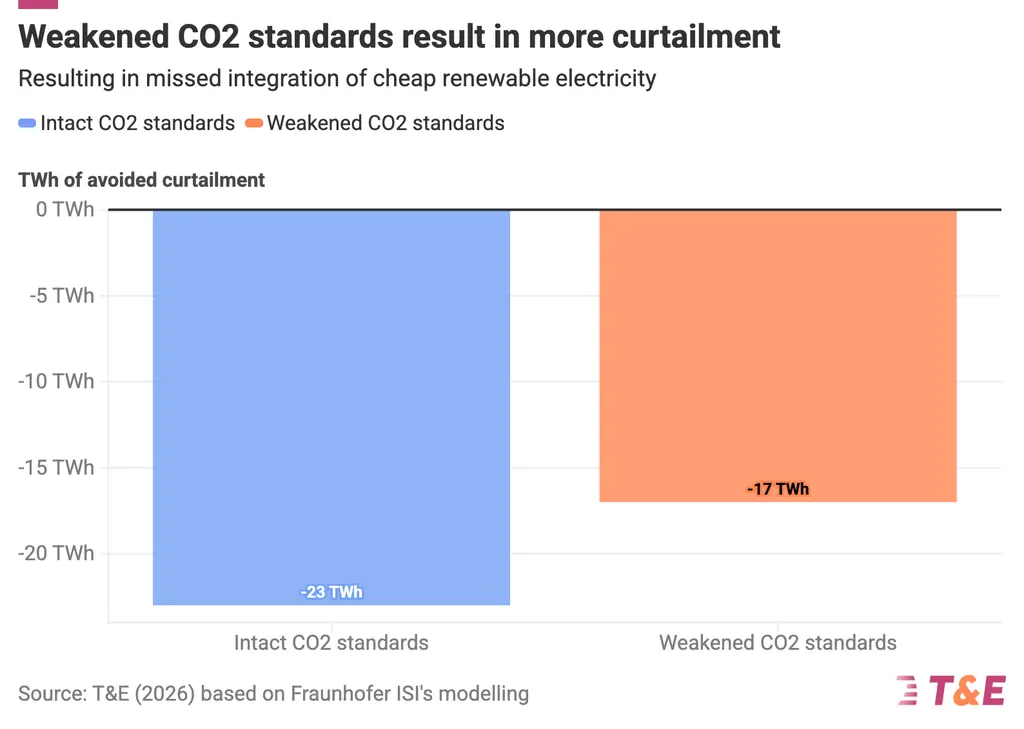
Weakened CO₂ standards hinders more solar PV deployment and increases curtailment. Additional solar deployment is 37% lower. And the decrease in curtailment is 25% lower compared to a situation with more EVs under intact CO₂ standards.
-
2
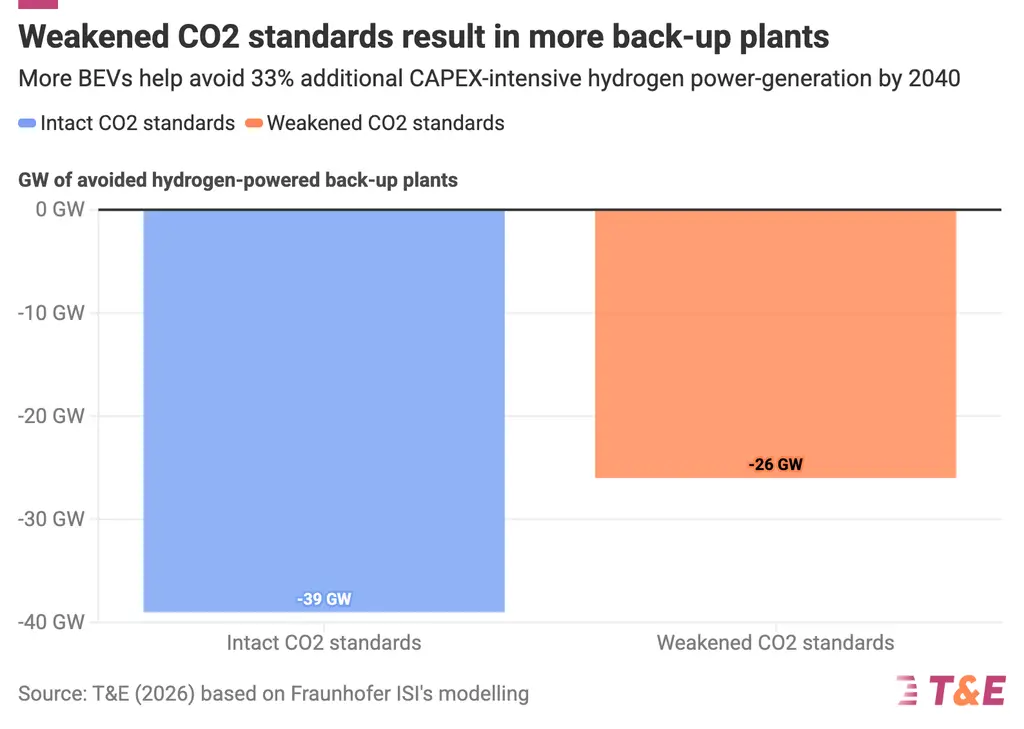
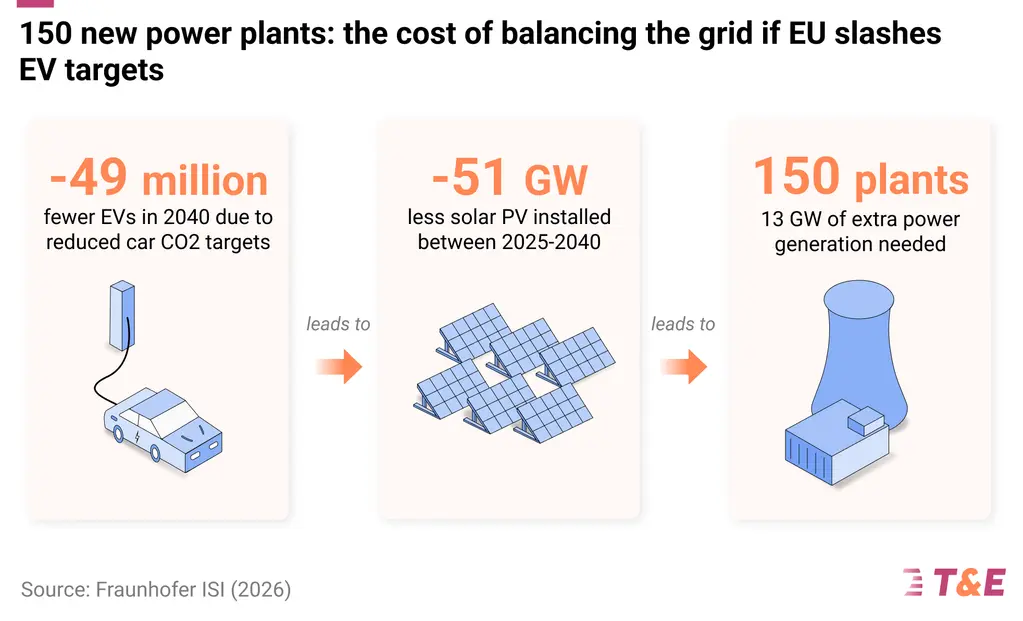
Fewer EVs for V2G result in more back-up capacity needed. With fewer EVs, the additional generation capacity needed in 2040 is 13 GW compared to a situation with intact CO₂ standards and more EVs. That is equivalent to 150 extra peaker plants.
-
3
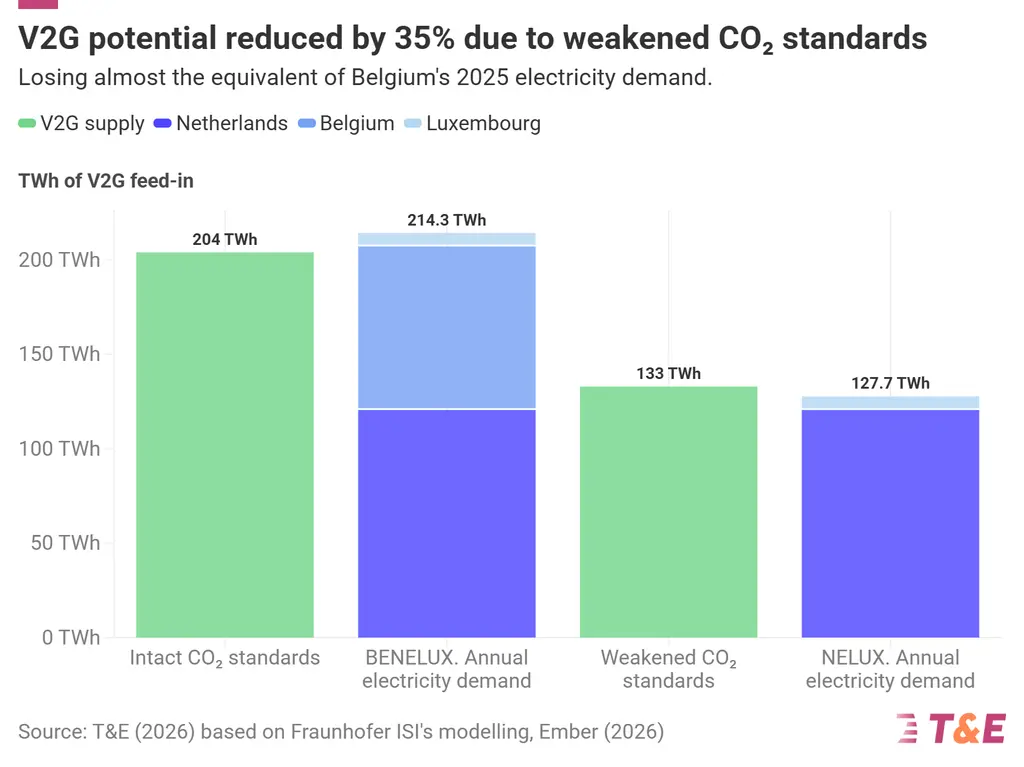
Weakened CO₂ standards reduce EVs as a major distributed storage resource, by 35%. If the standards are maintained, EVs could provide additional storage nearly equivalent to Belgium’s current annual electricity demand.
-
4
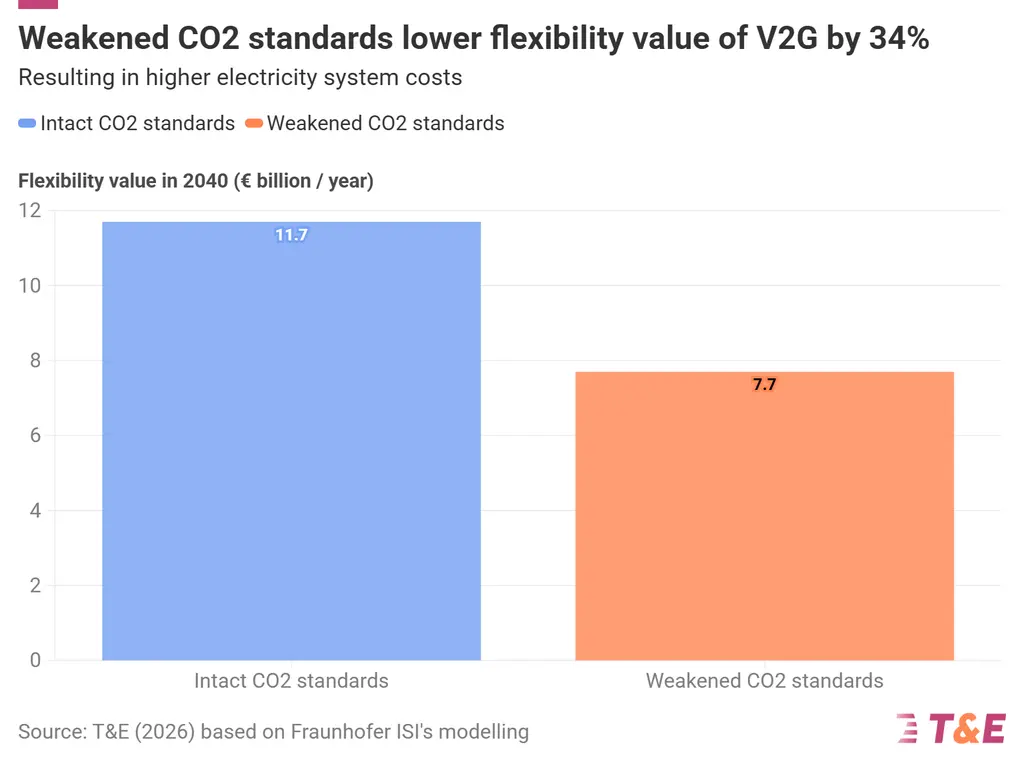
Fewer EVs results in higher electricity system costs / 34% fewer savings due to lower V2G potential. Under intact CO₂ standards, the annual savings due to the higher flexibility by V2G reach €11.7 billion in 2040, compared to €7.7 billion under weakened CO₂ standards.
-
5
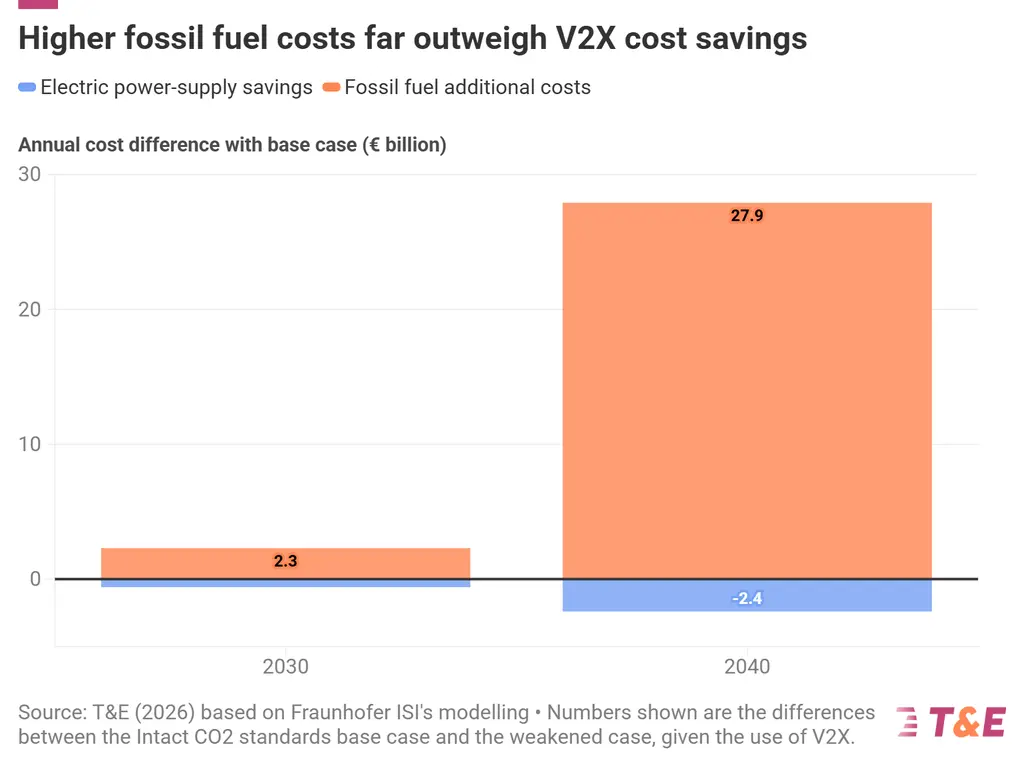
€25 billion of additional system costs by 2040 due to weakened CO₂ standards: Higher fuel costs far outweigh V2G savings for the power supply system. Higher expenditure on liquid fuels (approximately €27.9 billion) far outweighs the savings for the power supply system generated by V2G.
Introducing scenarios
The Commission proposed to change the EU’s CO₂ standards, doing away with the ban on the internal combustion engine and introducing a number of flexibilities for car manufacturers. But for the car and fossil fuel industry, these proposals do not go far enough. More drastic changes are demanded. Based on T&E analysis, carmakers’ EU demands (based on a leaked position paper of the industry association ACEA) would cut sales of Battery Electric Vehicles in half.
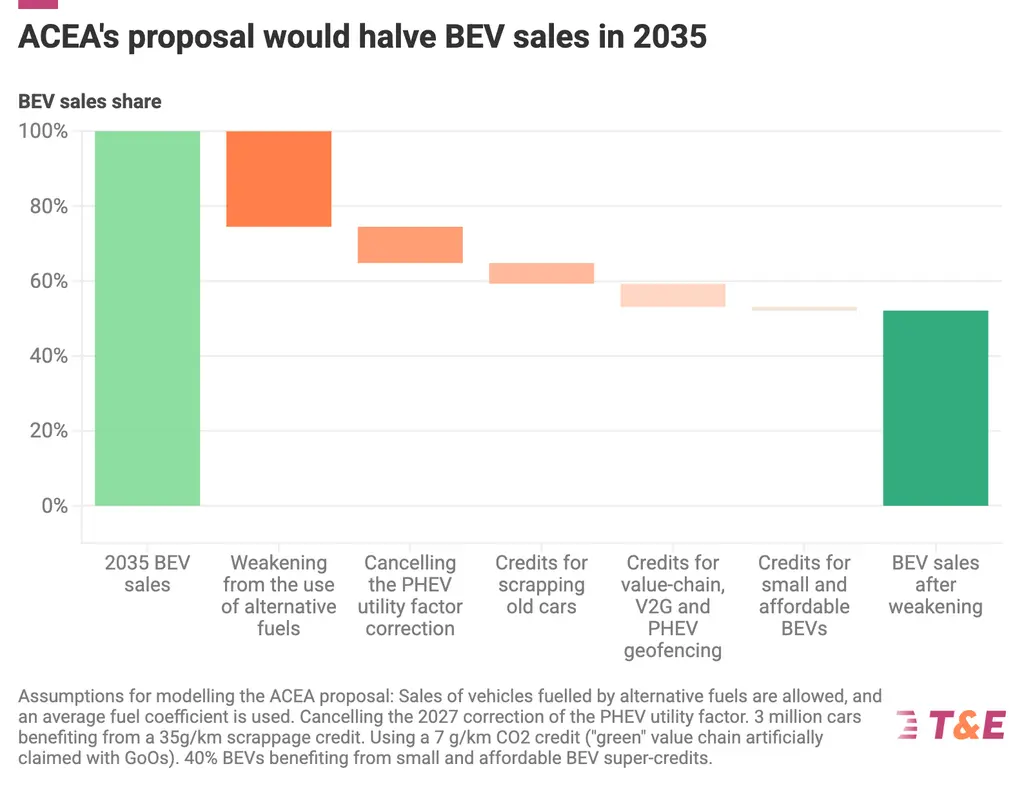
Much has been said about the implications of weakening the CO₂ standards for the future of the automotive sector. What has remained under the radar in discussions on weakened CO₂ standards is the impact on other sectors, notably the electricity sector. Further decarbonising the electricity sector will require accelerating renewables deployment and upgrading grids. But a growing share of renewables requires clean flexibility to be developed in lockstep.
In 2024, T&E commissioned a 'Batteries on Wheels' report. The report by Fraunhofer ISI demonstrated how a rapid electrification of road transport can help to integrate more renewables and generate savings in grid expansion costs thanks to the Vehicle-to-Grid (V2G) technology. The geographic scope of the study encompassed the European Union, the United Kingdom, Norway, and Switzerland
In 2026, we asked Fraunhofer ISI to repeat a similar analysis. However, this time, the car industry's wishlist to weaken the car CO₂ standards was used as input for the modelling to explore the longer-term impacts of far fewer EVs in the fleet on the electricity system.
Scope and assumptions used for this briefing
This briefing focuses on the longer-term impacts - in 2040 - of fewer electric vehicles on the potential of Vehicle-to-X (V2X) for the grid. V2X is a broader term than Vehicle-to-Grid (V2G) and refers to using the battery of electric vehicles to supply electricity to a building (Vehicle-to-Home), another vehicle (Vehicle-to-Vehicle) or any other electricity demand (Vehicle-to-Load). V2G refers specifically to the bidirectional flow of electricity between electric vehicles and the grid. Given the focus of this briefing on the grid impacts of more or less EVs, the term V2G will be used. The 2026 Fraunhofer ISI report also uses the terms V2G and V2X interchangeably.
The 2040 results of the V2G/V2X scenario in the Fraunhofer ISI report compares two scenarios: a V2G/V2X base case to a V2G/V2X worst case. In the first scenario, the EU’s 2023 CO₂ standards remain in place - with a full phase-out of new combustion engine vehicles in 2035. This is contrasted with a scenario whereby the proposals in a leaked position paper of the industry association ACEA are adopted. The Fraunhofer ISI report also assesses the situation in 2030 as well as the impact of ‘controlled charging’, but these elements are not covered in this briefing.
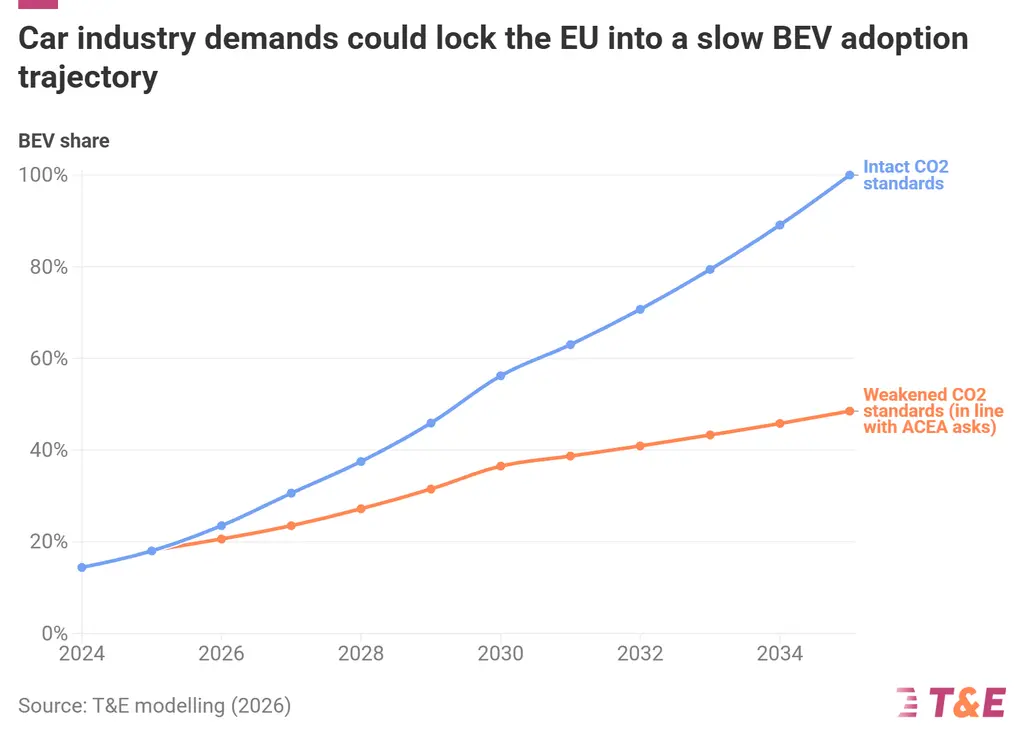
Where Fraunhofer ISI uses the terms ‘base case’ and ‘worst case’ scenario, this briefing opts for the description ‘intact CO₂ standards’ and ‘weakened CO₂ standards’. Under the scenario with intact CO₂ standards, the share of EV sales are at 58% in 2030 and at 100% in 2035. Under the scenario with weakened CO₂ standards, EV sales are much lower: At just 37% in 2030 and 49% in 2035, instead of 100%. These lower shares of EV sales over time have implications for the fleet composition. Under the scenario with intact CO₂ standards, there is a steady adoption of EVs, with a projected stock of 141 million in 2040. In contrast, the worst-case scenario assumes a slower Battery Electric Vehicle (BEV) uptake in the EU member states, resulting in a lower stock of only 92 million EVs in 2040.
The main result of weakened CO₂ standards is that more gasoline-fueled ICE vehicles remain in the fleet by 2040, instead of being replaced by Battery Electric Vehicles. The number of plug-in hybrid electric vehicles (PHEV) remains consistent across both scenarios, around 17 million PHEV in 2040.
The results presented here use the following conservative assumptions, which were also used in the 2024 Batteries on Wheels study:
In the 2024 Batteries on Wheels study, we included a more aggressive V2G scenario, whereby 50% of EVs participate in V2G in 2040. In this 2026 update, we use a more conservative assumption, whereby only 35% of EVs participate in V2G by 2040.
The number of PHEV in the fleet is similar in both scenarios (17 million PHEV in 2040) The study assumes that PHEVs cover half their mileage using electricity. But given the smaller battery size of PHEV, the study does not consider PHEV relevant for V2G purposes.
The cost of crude oil was estimated to be $30 per barrel in 2040 (€17 / MWh)
Findings in detail
The headline finding is that - by 2040 - smart charging and especially bidirectional Vehicle to Grid (V2G/V2X) by EVs represent substantial and lowest cost flexibility resources available to the EU with substantial benefits for renewable integration, system costs and infrastructure needs. Weakening the ICE phase‑out directly reduces available EV flexibility and lowers power‑system efficiency gains, especially in the longer term. Europe’s power system is rapidly becoming dominated by wind and solar, which sharply increases the need for short‑term flexibility to balance daily and weather‑driven fluctuations: Europe’s transition to a renewables-based power system will require large amounts of the flexibility offered by EVs.
This briefing highlights the negative impacts in 2040 of fewer EVs due to weakened CO₂ standards for the electricity system in several areas.
The geographic scope for the figures presented in this briefing refers to the EU27, Norway, Switzerland and the UK.
Finding 1: Weakened CO₂ standards hinders more solar PV deployment and increases curtailment.
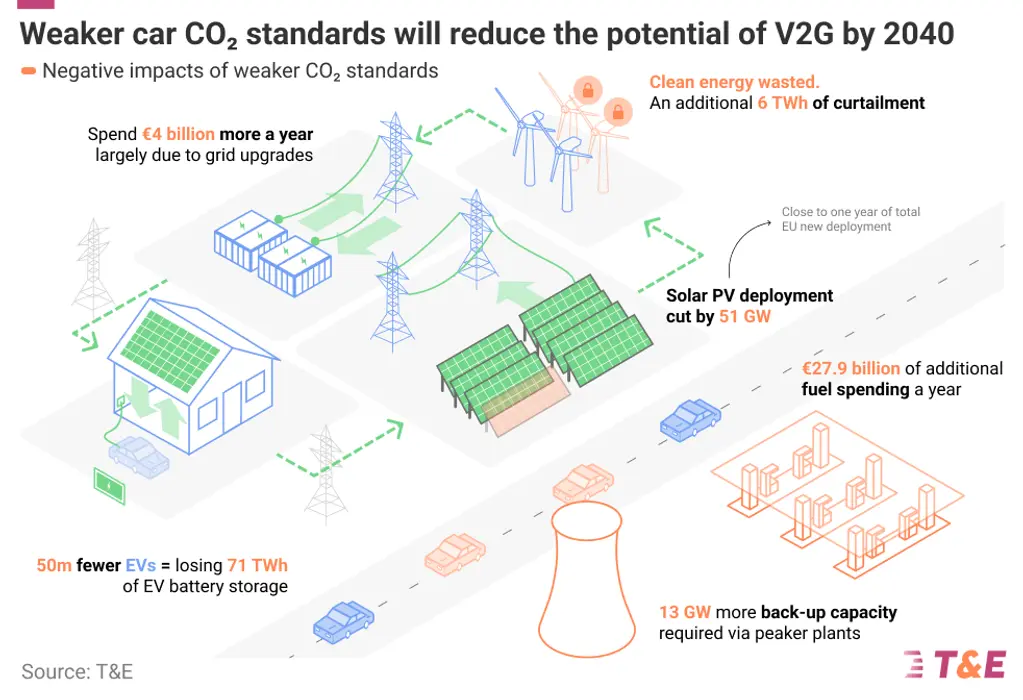
EVs are well suited to enable more renewables’ integration, in particular for solar PV. Intact CO₂ standards resulting in a larger fleet of EVs enable an additional 139 GW of solar PV capacity. Fewer EVs due to weakened CO₂ standards enable only 88 GW of additional solar PV capacity. Or 37% less than what intact CO₂ standards and more EVs could have enabled: That 51 GW less solar PV installed is almost equivalent to a full year of solar PV GW additions in the EU in recent years (e.g. 65 GW in 2025, 70 GW in 2024 - Ember).
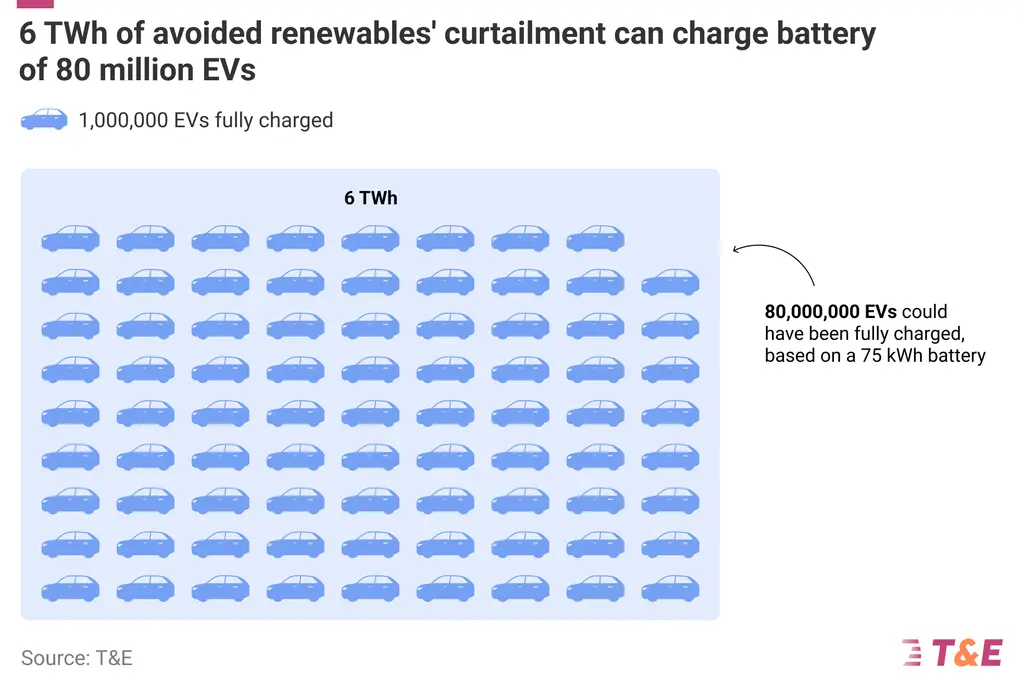
A smaller EV fleet leads to less availability of flexible capacity, which leads to a situation where renewables face more curtailment by 2040. V2G with a bigger fleet of EVs reduces curtailment by 23 TWh under the intact CO₂ standards scenario. With weakened CO₂ standards, curtailment is only reduced by 17 TWh. In other words, with 6 TWh more curtailment, the decrease in curtailment is 25% lower compared to a situation with more EVs under intact CO₂ standards. With those 6 TWh of curtailed renewables, 80,000,000 EVs (based on a 75 kWh battery) could have been fully charged.
Enabling more solar PV and reducing curtailment does not only result from shifting EV charging to those hours of the day with a high solar PV output. By 2040, V2G actually changes the cost-optimal electricity mix, because vehicle batteries can absorb midday solar peaks and shift energy to evening and night-time hours. Thanks to the greater number of ‘Batteries on Wheels’ in an ‘intact CO₂ standards’ scenario, the electricity system rewards investments in additional PV capacity while maintaining curtailment at manageable levels. This shows that the greater value added of V2G for the electricity system with a high share of renewables in 2040 does not only help to absorb surplus generation; It also improves the business case for a substantially more solar-intensive portfolio. As a result, the additional PV capacity enabled by V2G is an order of magnitude larger (in GW) than the reduction in curtailment indicates.
Finding 2 : Fewer EVs for V2G result in more back-up capacity needed
More EVs available for V2G would result in 39 GW less hydrogen-based back-up capacity by 2040. In the worst-case scenario with fewer EVs, only 26 GW less capacity would be needed. That 13 GW difference between the two scenarios by 2040 results in 33% less reduction for hydrogen-based back-up capacity compared to a situation with intact CO₂ standards and more EVs. 13 GW of back-up capacity implies that an additional 150 peak plants would need be built (based on an average capacity of 86 MW for Open Cycle Gas Turbines that will not be retired before 2040, based on Beyond Fossil Fuel’s Gas Database).
As a result, that back-up capacity will be expensive to run, because of a combination of relying on expensive gas with a high carbon cost or an expensive hydrogen as a fuel for these peaker back-up plants.
V2G can maintain system reliability with a significantly smaller fleet of dedicated peaking plants and stationary batteries. The adequacy function is increasingly provided by a coordinated, distributed storage resource – an electrified vehicle fleet – rather than by capital-intensive centralised assets.
Finding 3: Weakened CO₂ standards reduce EVs as a major distributed storage resource, by 35%
V2G converts the passenger-car fleet into a major distributed storage resource and triggers a structural re-optimisation of the generation portfolio. With intact CO₂ standards, EVs become the dominant source of short-term flexibility and support a structurally more solar-centric European power system. By 2040, V2G feed-in reaches approximately 204 TWh in the ‘intact CO₂ standards’ scenario. The ‘weakened CO₂ standards’ diffusion scenario reproduces these patterns at a reduced scale. In 2040, V2G still provides approximately 133 TWh of car-to-grid feed-in, but 35% less than in base case. That difference is almost equivalent to Belgium’s annual electricity consumption in 2025.
Finding 4 : Higher electricity system costs / 34% fewer savings due to lower V2G potential
With substantially fewer EVs, more money will need to be spent to operate the electricity systems (due to higher spending on e.g. gas and hydrogen-fired power plants, battery storage, etc). With intact CO₂ standards, more EVs will be able to capture more of the value of improved intra-day flexibility, increasing the annual cost savings of the EU-wide power system.
Under intact CO₂ standards, the potential savings due to the higher flexibility offered by more EVs could reach €11.7 billion in 2040. However, under weakened CO₂ standards, these system cost savings are reduced to €7.7 billion in 2040. Or 34% fewer savings.
Finding 5: €25 billion of additional system costs by 2040 due to weakened CO₂ standards: Higher fuel costs far outweigh V2G savings for the power supply system.
More EVs engaging in V2G offer advantages not only in terms of the electricity system. It is important to highlight that the cost savings go beyond the electricity system. A slower EV uptake may limit the increase in electricity demand, thereby reducing power‑sector costs. However, it increases expenditure on oil and associated CO₂ costs.
A slower EV uptake may limit the increase in electricity demand, thereby reducing power sector costs.: Around €2.4 billion. However, higher expenditure on liquid fuels (approximately €27.9 billion) far outweighs the smaller power-supply savings due to fewer EVs. As a result, weaker CO₂ standards increase the total system cost in 2040 by about €25.5 billion per year. While the additional fuel costs of weakened CO₂ standards remains relatively small in the short term (2030), the additional fuel costs balloon by 2040 (even when assuming very low oil prices). This result leaves no doubt that a high EV uptake resulting from keeping CO₂ standards intact - in combination with the V2G potential - is a cost‑efficient flexibility strategy in a European power system with a growing share of renewables.
Conclusion
In 2020, the European Commission’s own Energy System Integration Strategy described a potential transformation of the EU’s energy system, which would move away from “several parallel, vertical energy value chains, which rigidly link specific energy resources with specific end-use sectors”. For example, oil in the transport sector, with only a marginal role for electricity. Instead, energy system integration would combine cheaper renewables, energy storage innovation, electric vehicles and digitalisation to help decarbonise the EU’s economy.
This briefing serves as a useful reminder that all of the elements of this Energy System Integration Strategy are needed. The EU’s CO₂ standards are a crucial tool to deliver the electric vehicles and the rapid innovation on batteries needed. Decarbonising road transport and accelerating the decarbonisation of the electricity system cannot happen in silos and require joined-up thinking.
Related Articles
View All
Wave of affordable electric cars is boosting consumers' choice: sales of sub-€25,000 models set to rise sevenfold
Electric car choice is expanding rapidly thanks to EU clean car targets, but weakening the 2030-35 targets would put affordable models and Europe’s po...

EV progress report: 'Don't stop me now', the EV transition is delivering
The EU car CO₂ targets are delivering record electric car sales and a wave of affordable models. However, weakening the 2030-2035 target as currently ...
What is the situation with residual values in Europe?
Understanding how Residual Values have evolved and what has driven the change over the last years