Diesel: the true (dirty) story
This is T&E's report on why Europe’s obsession with diesel cars is bad for its economy, its drivers and the environment.
Interested in this kind of news?
Receive them directly in your inbox. Delivered once a week.
This report draws on a wide range of data and analysis to examine the underlying reasons for Europe’s diesel addiction, i.e. the biased regulations and taxes that have artificially created the bloated sales of diesel cars in Europe that until recently represented over half of the new car market. It also examines the consequences for health and the environment and wider economic effects of dieselisation.
Contrary to perceived wisdom it shows that diesel cars are not actually lower carbon than gasoline versions if emissions are considered across the full lifecycle of the vehicle.
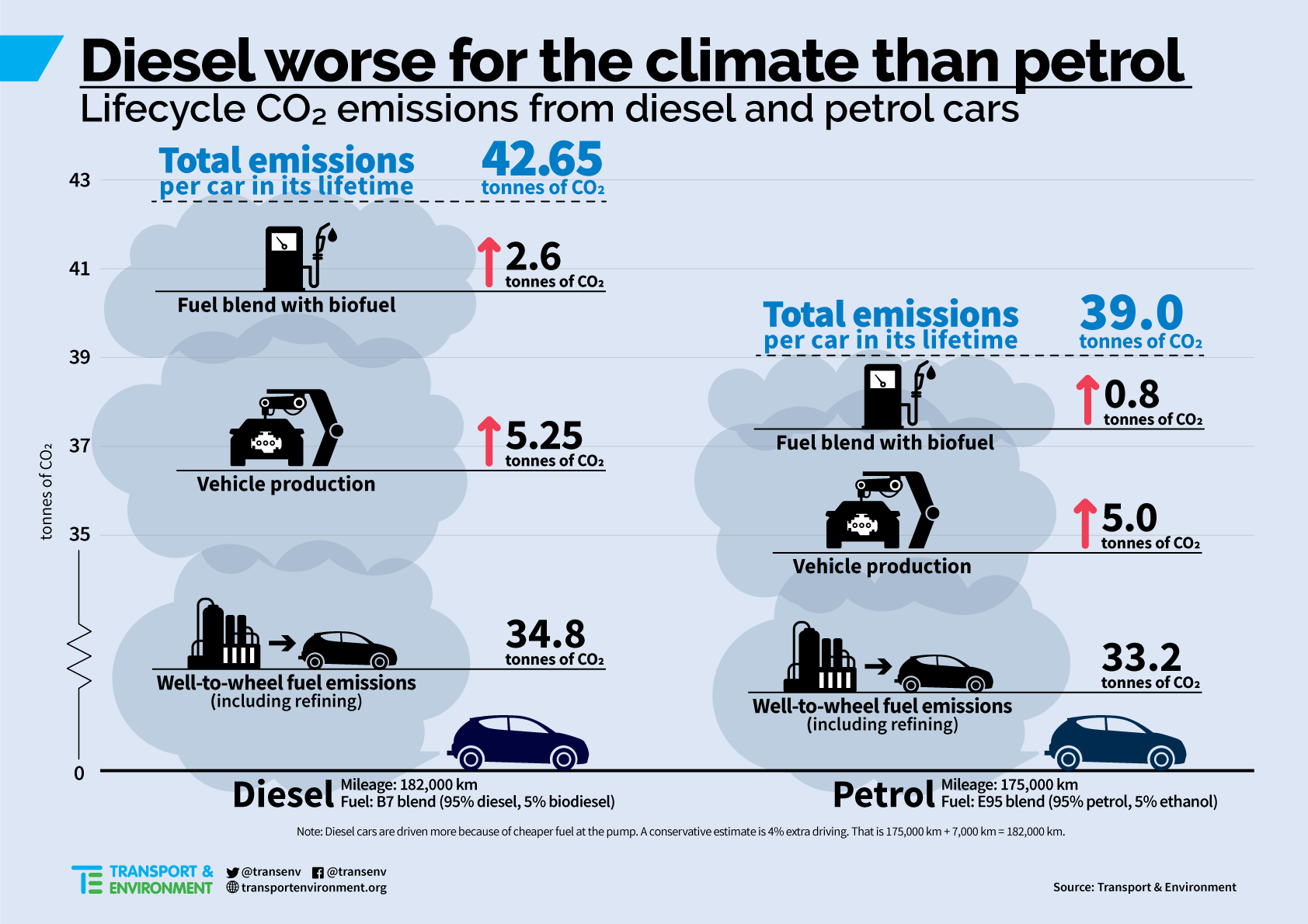
The average CO2 emissions of new diesel cars (119g/km) are only a few grams/km lower than an average (often less powerful) petrol car (123g/km). If the Euro 2,000 cost premium of diesel over petrol car is taken into account gasoline cars already outstrip their diesel counterparts. For example, hybrid systems are now no more expensive than diesels (and cheaper in some markets) but average 89g/km. In the medium term the opportunities to lower CO2 emissions from cars are primarily from gasoline and electric solutions. To 2050 electric is the most cost effective technology.
Since diesel is not better for the climate than petrol there is no justification for its preferential treatment.
As well as in English, the executive summary of the report is available to download in:
Related Articles
View All
Wave of affordable electric cars is boosting consumers' choice: sales of sub-€25,000 models set to rise sevenfold
Electric car choice is expanding rapidly thanks to EU clean car targets, but weakening the 2030-35 targets would put affordable models and Europe’s po...
EV progress report: 'Don't stop me now', the EV transition is delivering
The EU car CO₂ targets are delivering record electric car sales and a wave of affordable models. However, weakening the 2030-2035 target as currently ...

Unlock public EV charging price transparency and competition
T&E position on the revision of the Alternative Fuels Infrastructure Regulation for Light Duty Vehicles