City e-truck charging can cut road freight emissions by a fifth – study
The EU could slash truck carbon pollution by over a fifth (22%) in a decade by requiring its main cities to have electric truck charging infrastructure. That’s according to an analysis of truck flows data which identifies 173 cities and urban areas [1] where chargers are needed in 2030 to put Europe’s road freight on a path to zero emissions. Transport & Environment (T&E) said that next year the EU should set ambitious targets for e-truck chargers.
Interested in this kind of news?
Receive them directly in your inbox. Delivered once a week.
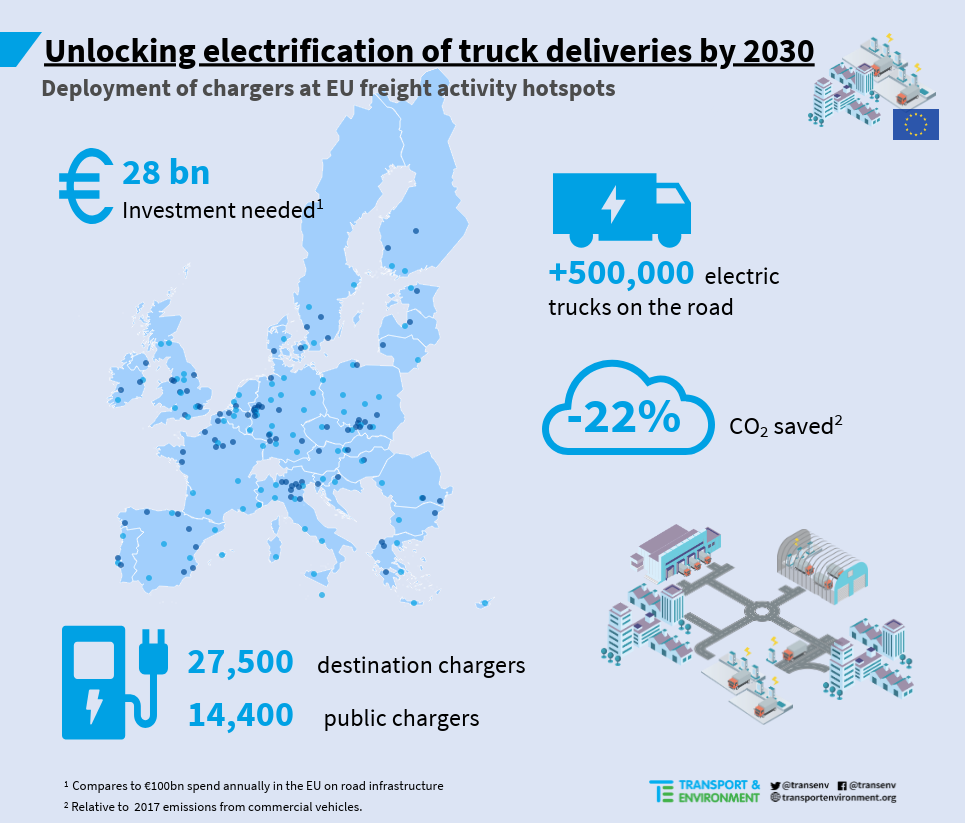
The 40,000 chargers at distribution centres and public places would require a €28 billion investment over 10 years, or €2.8 billion a year on average, the analysis finds. Currently €100 billion is spent on road infrastructure every year in the EU.
Lucien Mathieu, transport and e-mobility analyst at T&E, said: “Electric trucks are clean, cheaper to run and available today. But the lack of a European charging strategy and the underwhelming supply from European truckmakers is holding back the market. The EU needs to set ambitious targets for the roll-out of infrastructure and let Europe’s truck fleet go emissions free.”
Providing these chargers will serve half a million e-trucks and allow 43% of the EU’s truck trips to go emissions free by 2030, the analysis shows. Cities and towns would benefit from clean and quiet vehicles making home deliveries and supplying supermarkets.
T&E said next year’s review of the Alternative Fuels Infrastructure Directive (AFID) should only focus on electricity and green hydrogen infrastructure to be coherent with the EU Green Deal’s climate ambitions. Infrastructure to fuel gas trucks, which can be up to five times worse for air pollution than diesel and offer no path to decarbonisation, should be excluded under the law and thereby also disqualified from receiving EU funding. In 2022, the EU should also push truckmakers to accelerate the supply of zero-emission vehicles with more ambitious CO2 reduction targets when it reviews the 2030 standard.
Lucien Mathieu concluded: “Increasing the supply of zero-emission trucks and providing truck charging infrastructure opens the way to clean and quiet deliveries in cities. Emissions-free vehicles will boost the quality of life of millions of Europeans with less air and noise pollution.”
Note to editors:
[1] The cities and urban areas are a combination of the existing urban nodes under the TEN-T regulation and ‘hot spots’ for truck activity identified by T&E’s analysis.
Related Articles
View All
IRU and T&E call for EU framework to unlock semi-private truck charging

European businesses in the transport sector call for EU to maintain stability and ambition on decarbonising heavy-duty vehicles (HDVs)
“Don’t weaken CO2 standards for trucks”, European businesses urge the EU, as they signal strong demand for electric

Are electric trucks cheaper to operate than diesel?
A new T&E analysis looking at major truck markets in the EU