Tolling: the highway to green trucking
A briefing on how to implement the Eurovignette reform to clean up trucks.
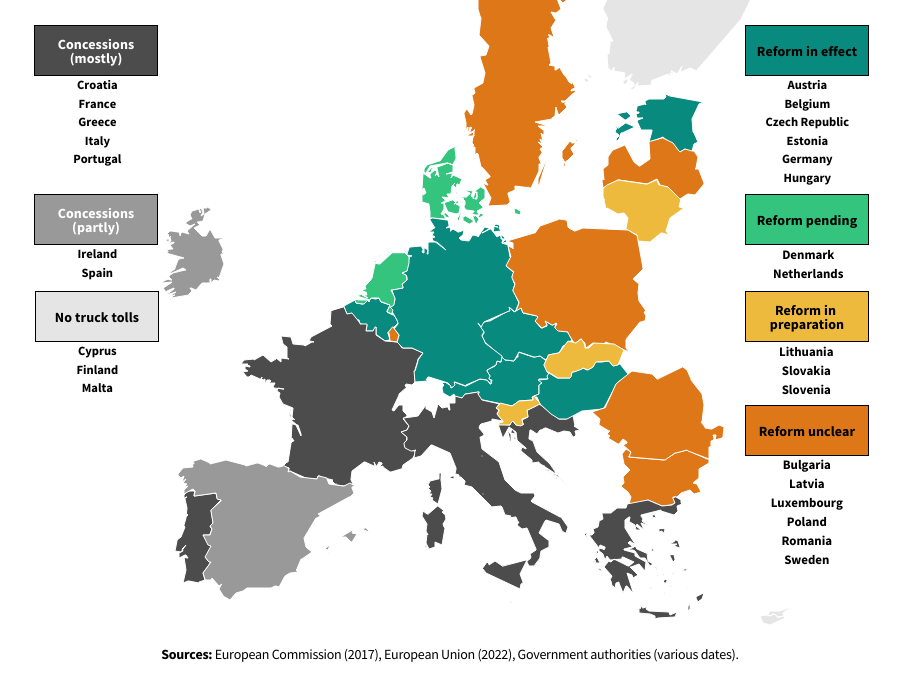
The requirement to vary truck tolls by CO2 is the centrepiece of the reform. Member states that toll trucks by distance – and where governments have retained the power to vary toll charges – are best placed to deliver change. These countries are Austria, Belgium, Bulgaria, Czech Republic, Germany, Hungary, Germany, Hungary, Poland, Slovakia and Slovenia. The majority of these countries have carried out the reform in time. However Bulgaria, Poland, Slovakia and Slovenia have not, and therefore need to do so as quickly as possible in order to comply with EU law. Lithuania (2024), Denmark (2025), the Netherlands and Romania (both 2026) will switch from time- to distance-based tolling systems soon. Denmark and the Netherlands have already passed laws to introduce CO2-based tolling systems, while Lithuania and Romania are in full preparation to do so.
In summary, by 2026, distance- and time-based tolls varied by CO2 are expected to be in force in 17 member states. This means that 62% of EU truck activity (measured in tonne-kilometres) will have a strong incentive to switch to zero-emission vehicles (ZEVs).
The most effective way to implement this reform is carrot-and-stick, that is to reduce tolls for cleaner trucks, and increase them for trucks that emit more. Incentivising cleaner trucks while at the same time disincentivising less efficient ones will most influence a truck’s total cost of ownership (TCO) and therefore, new truck purchases, a strategy that best reduces diesel consumption and emissions.
Overall, the Eurovignette revision is an opportunity-filled reform. Tolling according to CO2 and charging for air and noise pollution will aid the shift to zero-emission trucks. Thanks to the breadth and depth of the revision, policy-makers are given the tools they need to match ambition on climate and other externalities to their domestic political and societal landscape.
However, as the deadline to vary tolls by CO2 for countries with government-controlled tolls has just passed on 25 March 2024, Bulgaria, Latvia, Lithuania, Poland, Romania, Slovakia and Slovenia need to reform their systems as quickly as possible in order to comply with the new directive, while Luxembourg and Sweden will have to do so within the coming year.
Download the briefing to find out more.
Related Articles
View All
IRU and T&E call for EU framework to unlock semi-private truck charging

European businesses in the transport sector call for EU to maintain stability and ambition on decarbonising heavy-duty vehicles (HDVs)
“Don’t weaken CO2 standards for trucks”, European businesses urge the EU, as they signal strong demand for electric

Are electric trucks cheaper to operate than diesel?
A new T&E analysis looking at major truck markets in the EU