How much does Uber really cost?
Uber adds to pollution and congestion in cities all over the world. Ask Uber to clean up their act!
Uber is adding more polluting car trips to already-clogged European cities such as London and Paris, new analysis suggests – contributing to air pollution and climate change and exploding the company’s sustainability claims.
New data compiled by Euromonitor shows a surge in Uber drivers in Europe. In France, the number of reported private hire vehicle (PHV) drivers doubled in three years; in London almost doubled in three years.
This has made Uber a giant taxi company in Europe.
Since Uber’s arrival in London, its biggest European market, taxi and PHV trips have increased by roughly 25% in the capital. This data strongly correlates with a 23% increase in overall CO2 emissions for the taxi and PHV sector in the UK in the same period.
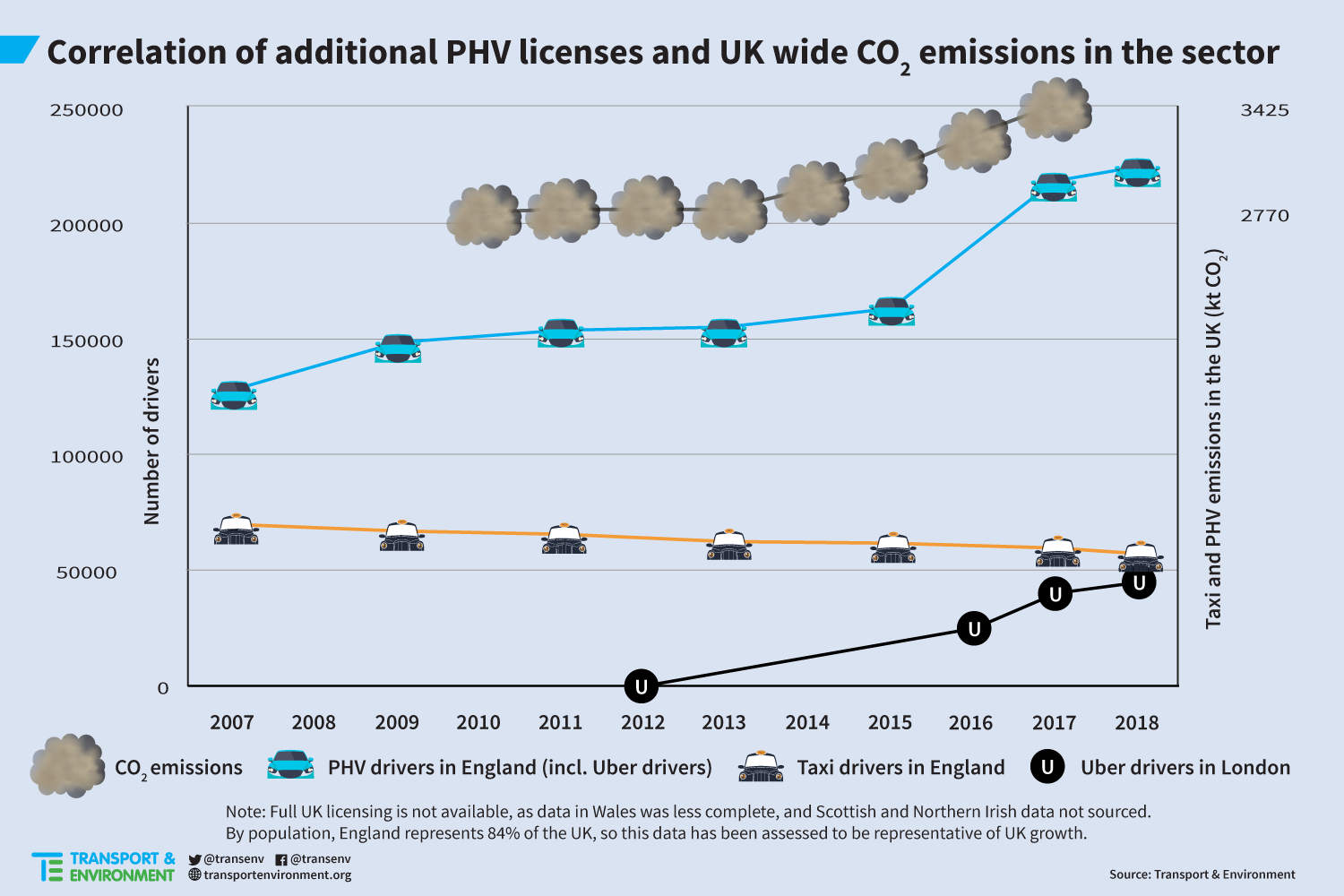
The analysis estimates that in London and Paris alone, the emissions of Uber taxi services could be as high as half a megatonne of CO2. This is equivalent to adding the CO2 emissions of an extra 250,000 privately owned cars to the road.
These kilometers have predominantly been driven by petrol and diesel cars, exacerbating the air pollution crisis in European cities. Worryingly, French government data from 2017 show that 90% of the registered private hire vehicles, which includes Uber, were diesel cars.
For more data and stats on Uber’s negative impact on cities, download our press release and full briefing below.

Related Articles
View All
The EU Clean Corporate Vehicles Regulation: the industrial and economic benefits of “Made-in-EU” electric company cars
New independent modelling by Fraunhofer ISI shows that implementation of the Clean Corporate Vehicles Regulation could deliver up to €48bn in value cr...
Rapid transition to electric company cars could generate 344,000 EU jobs by 2030 - study
Setting targets on companies to go electric and limiting financial support only for company cars that are electric and Made-in-EU would see economic g...

Franco-German car deal a ‘historic mistake’ that weakens climate ambition and Europe’s car industry
Deal to loosen the EU’s car CO₂ standards and IAA requirements a ‘historic mistake’ that puts Europe’s position in the global EV and battery race in j...