80% of EU oil imports now supplied by non-European companies – study
Non-European companies supply four-fifths of Europe’s oil imports, with Russian firms supplying more than one-third (36%) of imported crude, a new study on Europe’s foreign oil dependency has found. Just two of the top 10 oil suppliers to the EU are European, and most of our imported oil is supplied from unstable countries.
Interested in this kind of news?
Receive them directly in your inbox. Delivered once a week.
Rosneft and Lukoil, both Russian-owned companies, account for the highest share of crude oil imports to the EU, according to the study by Cambridge Econometrics for Transport & Environment. Cambridge Econometrics produced a map showing trade flows of oil into Europe.
Laura Buffet, oil officer at T&E, said: “Europe’s profligate use of oil is filling the pockets of big oil companies in unstable countries including Russia and Libya. Transport’s thirst for imported oil and diesel costs every citizen around €300 a year – money that flows out of the European economy.”

Europe’s dependence on crude imports has increased sharply in the past 15 years, as has its dependence on diesel imports which doubled between 2001 and 2014 to €35 billion. At the same time, EU domestic production and crude oil imports from countries with a very low risk of geopolitical instability, such as Norway, have decreased – worsening Europe’s energy insecurity.
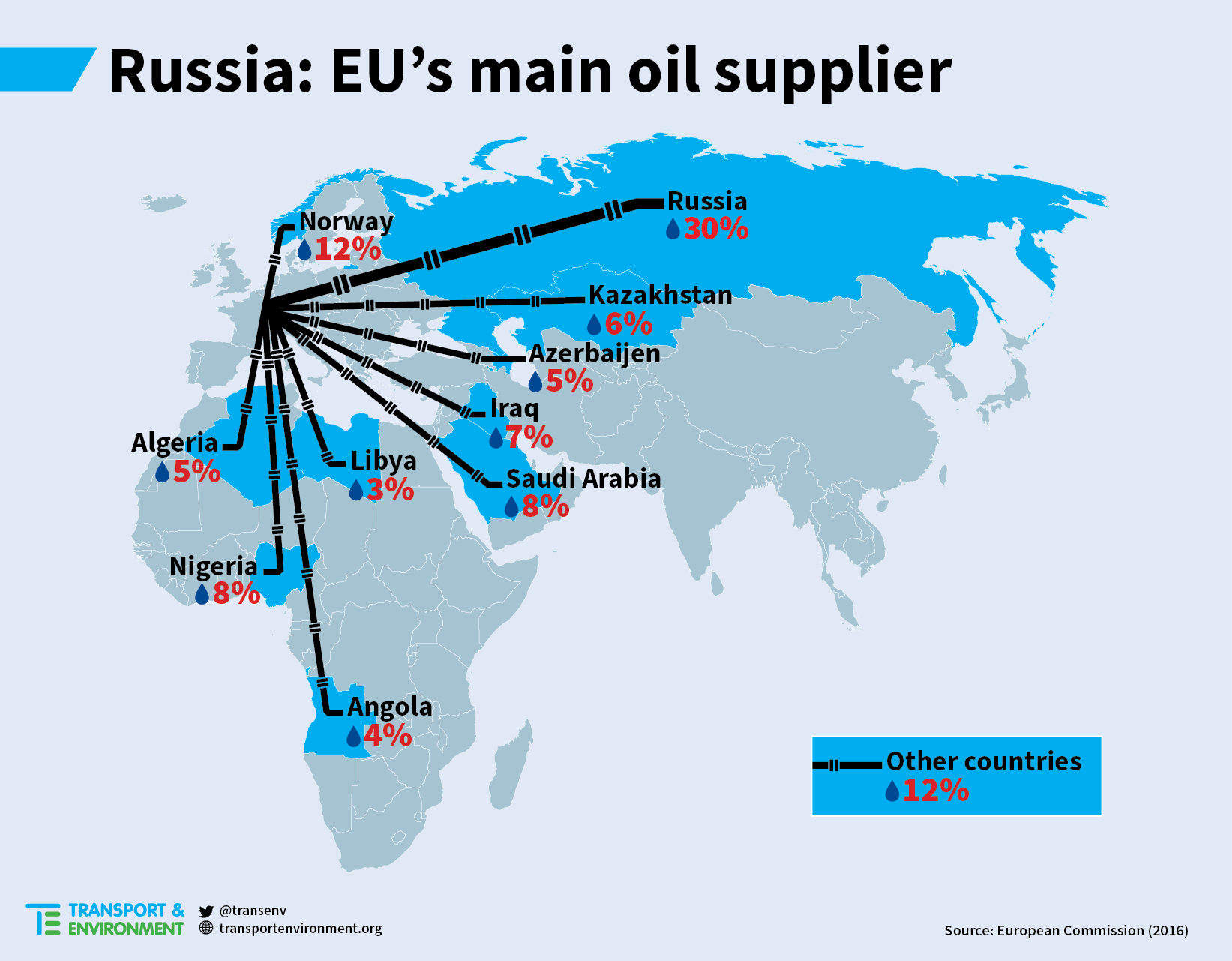
Transport is oil’s biggest customer, driving two-thirds of the demand for final petroleum products in Europe. Measures to decarbonise transport would deliver substantial economic, environmental and energy security benefits because burning oil is directly linked to CO2 emissions. According to a previous Cambridge Econometrics study, driving the shift to electric vehicles would lead to a 1% increase in EU GDP, create up to 2 million additional jobs and reduce emissions from cars and vans 83% by 2050.
The Commission is scheduled to publish a European Strategy for Low Emission Mobility on 20 July, along with announcing the agreement with member states on how much it proposes to cut emissions from the transport, housing and agriculture sectors, which are not part of the emissions trading system (the so-called Effort Sharing Decision). T&E is calling on the European Commission to: propose ambitious new CO2 targets for cars, vans and truck for 2025; develop a comprehensive strategy to drive electrification of transport; take measures to cut shipping and aviation emissions; and end all support for unsustainable biofuels.
Laura Buffet added: “Environmental protection and energy security are two sides of the same same coin. Ambitious plans to decarbonise transport will slash oil demand and ensure our money stays here, driving innovation, boosting jobs and reducing energy insecurity. This is a win-win for Europe.”
Related Articles
View All
The EU Clean Corporate Vehicles Regulation: the industrial and economic benefits of “Made-in-EU” electric company cars
New independent modelling by Fraunhofer ISI shows that implementation of the Clean Corporate Vehicles Regulation could deliver up to €48bn in value cr...

Rapid transition to electric company cars could generate 344,000 EU jobs by 2030 - study
Setting targets on companies to go electric and limiting financial support only for company cars that are electric and Made-in-EU would see economic g...

Franco-German car deal a ‘historic mistake’ that weakens climate ambition and Europe’s car industry
Deal to loosen the EU’s car CO₂ standards and IAA requirements a ‘historic mistake’ that puts Europe’s position in the global EV and battery race in j...