ReFuelEU’s first year shows the mandate works
Now Europe must unlock e-SAF investment.
The European Union Aviation Safety Agency (EASA) published today its Annual Technical Report on ReFuelEU Aviation (for 2025 data), providing the first full picture of the EU sustainable aviation fuel (SAF) market since the Regulation’s mandatory targets came into force.
The report sends an important signal: the EU’s SAF mandate works. In its first year of implementation, the 2% SAF target was not only met but exceeded. Around 1.1 million tonnes of SAF were supplied at EU airports in 2025, equivalent to 2.8% of aviation fuel supplied (a sharp increase from 0.6% in 2024).
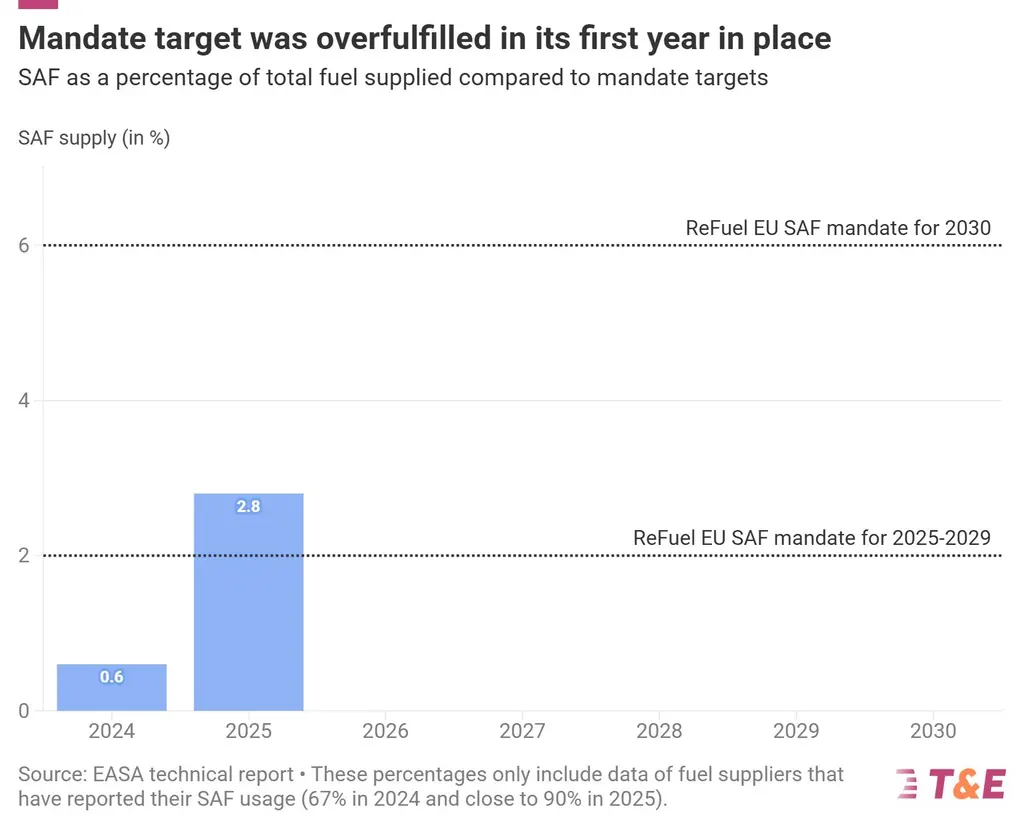
This demonstrates that clear and enforceable mandates can drive quick market uptake. But the data also expose significant weaknesses in Europe’s current SAF supply chain and, crucially, the lack of progress in scaling up synthetic aviation fuels (e-SAF).
SAF supply is growing, but remains heavily dependent on problematic feedstocks
The overwhelming majority of SAF supplied in Europe continues to come from the hydroprocessed esters and fatty acids (HEFA) pathway, using waste oils and fats as feedstocks.
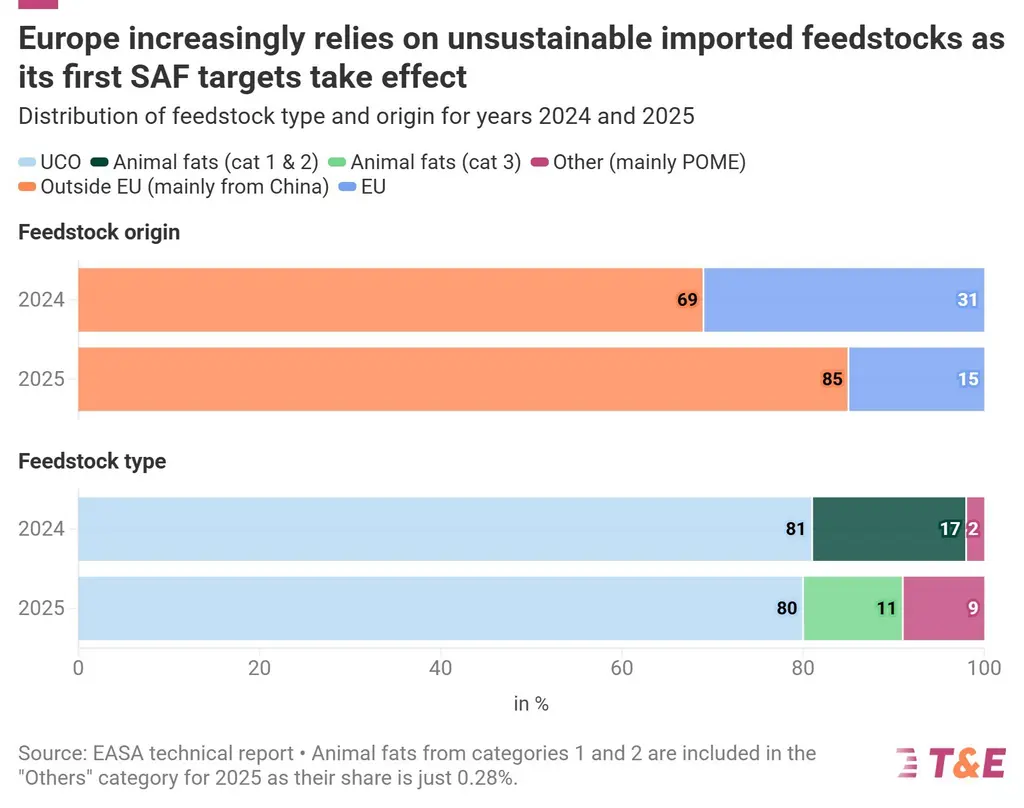
Used cooking oil (UCO) remains by far the dominant feedstock, accounting for around 80% of EU SAF supply. This is particularly concerning given the widespread fraud and misclassification risks associated with UCO supply chains. Europe should not build its long-term aviation decarbonisation strategy around increasingly scarce and fraud-prone waste feedstocks.
At the same time, the use of Category 3 animal fats for SAF has surged, now accounting for around 11% of EU SAF supply. These fats are already valuable feedstocks for existing industries, including oleochemicals, animal feed and other biofuel applications. Diverting increasing volumes into aviation risks simply shifting emissions elsewhere rather than delivering genuine additional climate benefits.
POME-based SAF has also surged, accounting for around 6% of EU SAF supply. Palm-Oil Mill Effluent (POME) is a by-product of palm oil production, meaning its use for aviation risks creating additional demand for a feedstock closely tied to the palm oil industry and its well-documented environmental impacts.
The geographical picture is equally concerning. While 84% of SAF is refined within the EU, 85% of the feedstocks used to produce it are imported, up from 69% the previous year. China is still the main source of these imported feedstocks.
"Europe is therefore building a SAF market that remains heavily dependent on imported feedstocks whose availability is limited and whose sustainability credentials are increasingly under scrutiny. This is not a credible long-term strategy for decarbonising European aviation." Camille Mutrelle, Aviation Policy Manager says.
Europe’s e-SAF pipeline is there, but investment is not
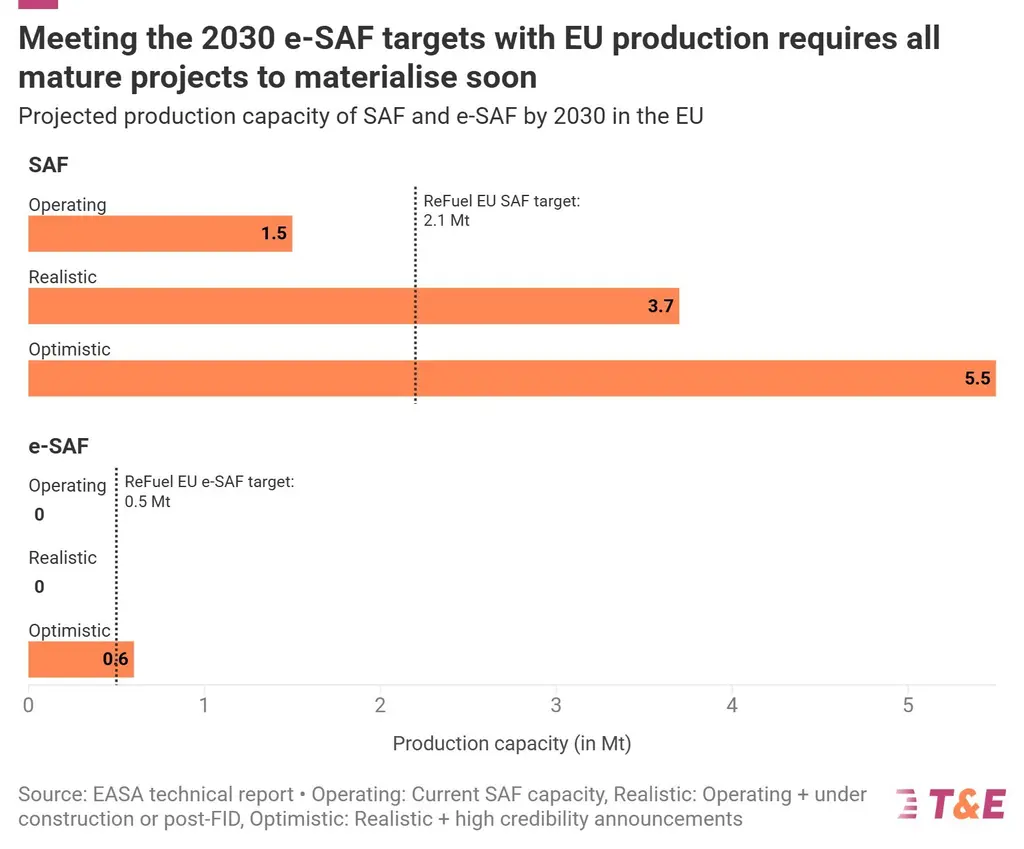
The most striking finding is the continued absence of commercial-scale e-SAF investment.
EASA’s assessment identifies around 60 e-SAF projects in development across Europe, yet none has reached a final investment decision (FID). EASA’s supply projections indicate that all the projects considered highly credible will need to materialise soon for Europe to meet its upcoming synthetic aviation fuel targets.
Three priorities for the EU
1. Protect the ReFuelEU framework, including the e-SAF sub-target
The answer to the lack of e-SAF investment should not be to weaken the regulatory framework or dilute the dedicated e-SAF sub-target. Instead, the EU should provide investors with confidence that the targets adopted today will remain in place.
Europe does not lack e-SAF projects, but it lacks the investment and confidence needed to turn them into reality. Maintaining a stable and credible e-SAF mandate is essential to turning Europe’s announced projects into operating plants.
2. Move from project announcements to final investment decisions
The next challenge is turning Europe’s e-SAF project pipeline into actual production. De-risking mechanisms are essential to create revenue certainty for project developers. The planned German pilot double-sided auction is an important step. But Europe should not stop there. An EU-wide market intermediary running double-sided auctions could help aggregate demand, reduce investment risk and unlock the first wave of commercial e-SAF projects. The Commission itself has committed to exploring an EU-wide approach to double-sided auctions for sustainable and synthetic fuels.
3. Diversify Europe’s SAF supply beyond imported waste oils
The EASA data underline the vulnerability of Europe’s current SAF supply model. With 85% of SAF feedstocks now originating outside the EU, Europe remains highly exposed to international waste-oil supply chains.
The European Commission’s proposal to phase out EU ETS support for UCO-based SAF from 2030 can help create a stronger incentive to diversify the market towards other sustainable pathways.
Related Articles
View All
Tackling contrails could avoid 10 years of aviation-related climate warming - new research

A way forward for contrail mitigation
T&E briefing on Klima Consulting’s review of the science and technology of contrail mitigation
