Modernising the EU’s rail ticketing regulation
How to streamline passenger rail travel across Europe
Download
Booking a rail ticket is a burdensome process
The upcoming EU Single Ticketing package should mandate commercial negotiations between rail operators and booking platforms to ensure tickets are displayed and sold across platforms
In this report we investigate the rail equivalent journeys to routes among the most heavily frequented by aviation in the EU. Our results highlight the current weaknesses of rail booking in Europe that require urgent attention in the upcoming Single Ticketing Package. The EU Single Ticketing package should mandate commercial negotiations between rail operators and booking platforms to ensure tickets are displayed and sold across platforms under fair, reasonable, and non-discriminatory terms so that passengers can buy a single train ticket from the beginning to the end of their journey across Europe with full passenger rights.
-
1
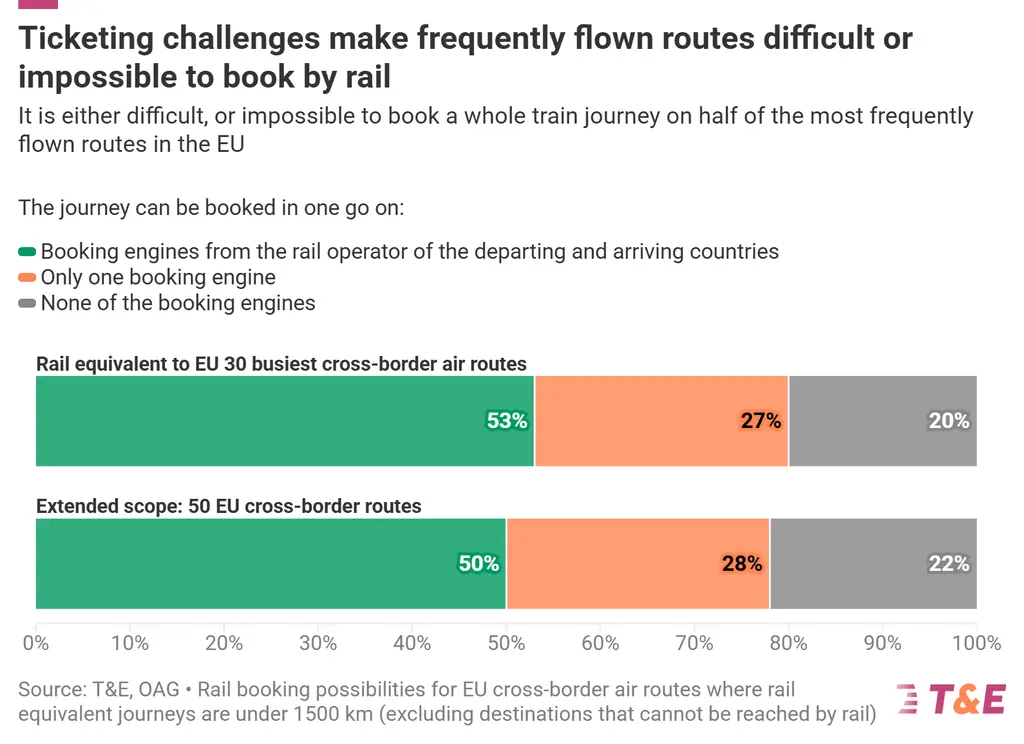
Most passengers rely on booking platforms from their local incumbent operators to book rail tickets. Yet, when looking at the rail equivalent to the 30 most busiest aviation routes in Europe, 20% of the international routes we studied cannot be booked in one go from major rail companies booking platforms, even though these routes are frequented by thousands of flights, emitting thousands of tonnes of CO2 every year. The mismatch is striking, and highlights a major shortfall in rail competitiveness.
-
2
Booking possibilities from incumbent rail operator’s booking platforms fall short, especially for longer distances: by increasing the geographical range of our analysis, we observe that more than half of the journeys above 900 km studied are unbookable in a single booking from the beginning to the end of a journey between EU countries.
-
3
Independent platforms provide more cross-border options, with 77% of journeys above 900 km possible to book a whole journey in one single booking. Yet, prices between different platforms greatly vary. T&E’s case studies in this report show prices up to six times more expensive on independent booking platforms than rail operators.
-
4
On more than half of the routes analysed, operators do not display all available journeys including competitors' tickets. This practice not only prevents passengers from easily comparing and booking the most suitable services on the same route, but also keeps them unaware of the very existence of these alternatives, even though they may be cheaper than those offered by incumbent operators.
On more than half of the routes analysed, operators do not display all available journeys including competitors' tickets. This practice not only prevents passengers from easily comparing and booking the most suitable services on the same route, but also keeps them unaware of the very existence ofthese alternatives, even though they may be cheaper than those offered by incumbent operators.
What is the Single Ticketing Package
This package provides a crucial opportunity to streamline and improve passenger’s booking experience of European railways tickets
The Single Ticketing Package includes:
The Multimodal Digital Mobility Services Regulation (MDMS),
Single Digital Booking and Ticketing Regulation (SDBTR)
and the revision of the Rail Passenger Rights Regulation (RPRR)
This package provides a crucial opportunity to streamline and improve passenger’s booking experience of European railways tickets, enabling people all over the EU to choose climate friendly transport with full passenger rights. The MDMS file regulates tickets that platforms sell and display for rail, air, sea, and road transport that is long-distance, medium-distance and regional. The SDBTR regulates rail operators sharing ticket data for long-distance, medium-distance, regional, excluding urban and metropolitan services.
This has the potential to improve and introduce:
-
1
The Multimodal Digital Mobility Services Regulation file may mandate major booking platforms, including third party platforms such as Trainline and incumbent operators booking platforms, such as SNCF Connect or DB Navi, to show all existing train connections in their geographical scope. This could enable passengers to view all available tickets, including the cheapest prices available.
-
2
The Multimodal Digital Mobility Services Regulation file could introduce an anticipated requirement for all platforms including air, rail, bus and ferry tickets to disclose the greenhouse gas (GHG) emissions associated with their journey at the point of booking their ticket. In the European Commission Eurobarometer on MDMS published in March 2025, three in four Europeans said climate impact was important when planning a regional or long-distance journey.
-
3
The Single Digital Booking and Ticketing Regulation file could mandate rail companies to share their ticket data with all platforms in order to create a through or combined ticket for passengers for their entire international rail journey. Progress on MDMS and SDBTR could significantly ease passengers' experience of booking international rail travel on one website, and increase the visibility of existing connections for passengers, including extras such as bicycle spaces. This file could also encourage operators to share their cancellation and delay data, improving passenger access to real-time journey information.
-
4
The Rail Passenger Rights Regulation could improve passenger rights and enshrine the existing CER Agreement of Journey Continuation (AJC) supplied by some operators into law. This could create a “hop in the next train” passenger right between all existing rail operators when you missed your connecting train in the event of a delay, and pay for assistance covering food and accommodation should you have to stay overnight or face long delays as a result of train delays or cancellations when passengers are travelling using connections between different rail operators. This could go above the limited scope of the AJC by applying also to domestic only connections and not exclusively to cross-border journeys.
What is the mandate of the EU Single Ticketing package?
President Von Der Leyen’s 2024 political guidelines
“To achieve our climate objectives, we also need to make it easier for people to shift to more sustainable options. This is notably the case with mobility. Cross-border train travel is still too difficult for many citizens. People should be able to use open booking systems to purchase trans-European journeys with several providers, without losing their right to reimbursement or compensatory travel.
To this end we will propose a Single Digital Booking and Ticketing Regulation, to ensure that Europeans can buy one single ticket on one single platform and get passengers’ rights for their whole trip.”
We are awaiting a proposal on three crucial files under the Single Ticketing Package from the EU Commission imminently which will then be scrutinised by the EU’s co-legislators in the coming months. We urge decision makers to reflect on the findings of our study, and agree to an ambitious Single Ticketing package that prioritises passengers and the reduction of the EU’s transport emissions which remains the only economic sector where emissions are still above 1990 levels.
Policy recommendations
The report findings make a case for new requirements on rail operators and independent booking platforms
Across the report, several case studies show shortcomings of booking rail tickets across the EU. Taking rail ticketing out of the Stone Age requires turning these recommendations into reality:
-
1
All major rail operator booking platforms with significant market power should be required to display and sell available tickets domestically and internationally. This includes selling and displaying willing competitors’ tickets under FRAND (Fair, Reasonable, and Non-Discriminatory terms), to ensure passengers can access the best ticket for their journey.
-
2
Rail operators with significant market power should be required to share journey data with other willing operators and third party platforms under FRAND. This includes fares, delays, cancellations, disability or bike access and real time data so that passengers have access to all relevant information for their journey regardless of where they booked their tickets.
-
3
Third party booking platforms with significant market power should be mandated to display and sell tickets from all willing operators including all ticket discounts and offers, to ensure passengers can access the cheapest available tickets and current journey data.
Related Articles
View All
EU Passenger Package: a golden opportunity to maximise green travel
The EU Passenger Package still falls short of aligning with the EU’s climate targets and is not harmonious enough with the EU’s rail policy agenda

Position Paper on the Connecting Europe through High-Speed Rail Own-Initiative Report
The EU Parliament can enhance the ambition of the implementation of the EU Commission plan, but some additional risks in it need to be addressed

New ticketing rules would still mean 43% of EU's busiest cross-border flight routes are hard or impossible to book by train
Despite being a huge leap for passenger rights, the EU Passenger Package will not ensure those taking international trains will always be able to get ...