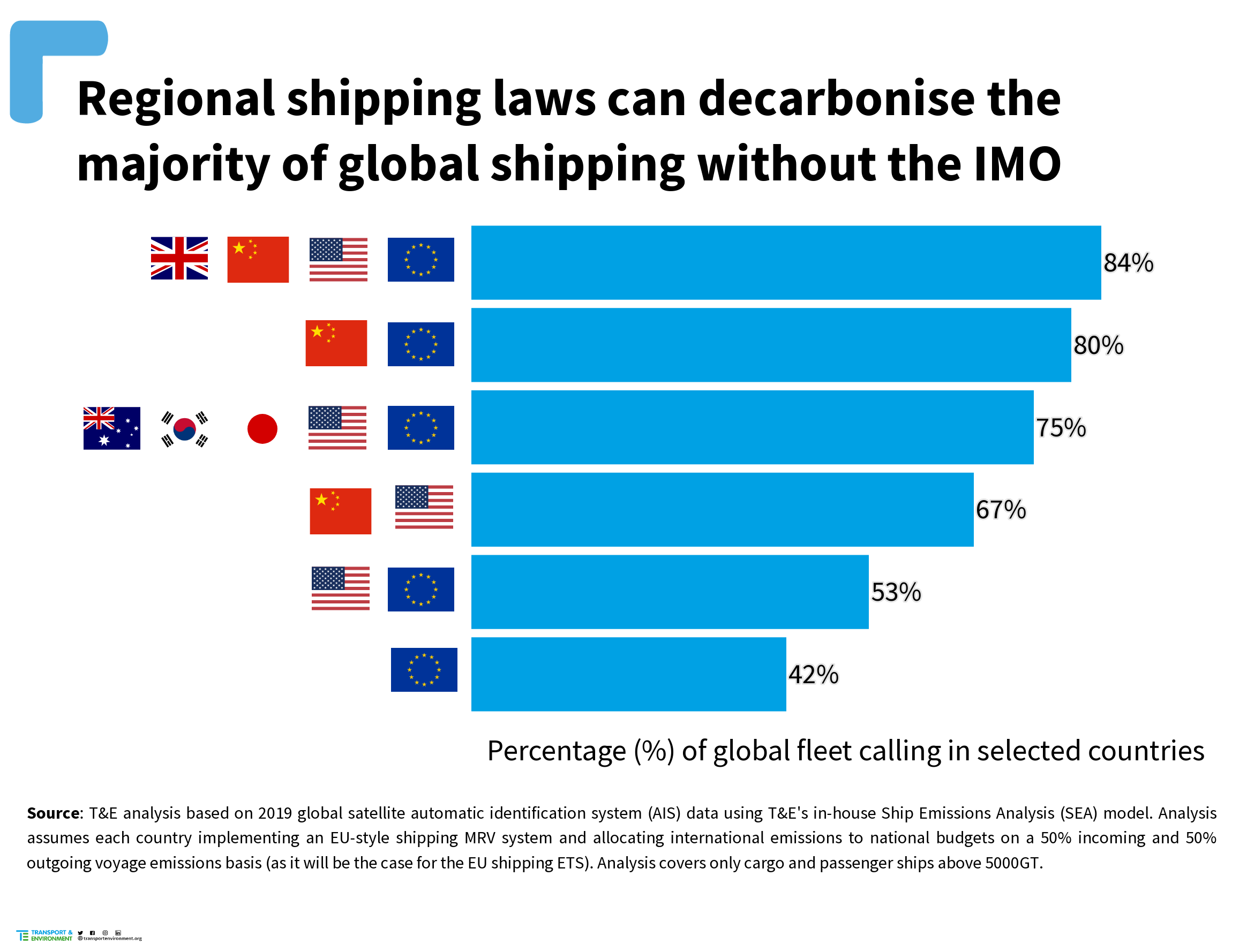
Europe, China and US could decarbonise 84% of global shipping emissions without IMO
With the vast majority of ships calling at European, Chinese and US ports, regulation of shipping emissions in these economies would be enough to decarbonise shipping globally
84% of shipping traffic goes through Europe, China and the US, a new Transport & Environment (T&E) study shows. If these economies were to regulate ships calling at their ports, they could decarbonise the lion’s share of the industry and in doing so bypass the “ineffective” International Maritime Organization (IMO), says T&E.
Jacob Armstrong, sustainable shipping officer at T&E, said: “Efforts to decarbonise shipping at the IMO have so far been miserable. The need for consensus at the global level has brought us nowhere. But there is a much easier way to do it. With the vast majority of ships passing through Europe, China and the US, these leading economies can unilaterally regulate emissions without relying on the ineffective IMO.”
While China, Europe and the US only account for 40% of shipping emissions, the vast majority of ships call at one of their ports. T&E calls on the three economies to agree on measures to reduce their maritime emissions including carbon markets, pollution taxes, energy efficiency targets and zero-emission fuel standards to create a de facto global regulatory regime.