EU fleets law could provide over half the EV sales carmakers need in 2030 - new research
But only if lawmakers increase the proposed fleets targets to require large companies to lead the EV transition
Download
A new EU law to electrify the vehicle fleets of large companies could deliver 57% of the electric vehicle (EV) sales that carmakers need in 2030, new T&E research finds. While carmakers claim there is insufficient EV demand to meet their 2030 EU CO2 targets, T&E’s analysis shows that an ambitious company cars law would deliver 2 million new EV sales. But that’s only if the proposed fleet electrification targets are increased. If the European Commission proposal is left as it is, EU car manufacturers would secure only 37% of the electric sales needed to meet their EU CO2 targets [1].
The EU proposal sets only a 45% target, on average, for member states to electrify new cars registered by large companies [2], which T&E said would fail to realise the demand-driving potential of the law. T&E analysed the impact of increasing this target to 69% and excluding plug-in hybrids, in line with the medium ambition scenario of the EU’s own Impact Assessment[3]. The T&E analysis finds all EU carmakers would see a significant share of their EV sales secured, with BMW (72%), Volkswagen (61%) and Volvo (59%) seeing the biggest gains.

Targets proposed by the EU Commission mean business as usual
Large companies should be clearly leading the EV market, T&E said, but under the Commission’s proposed targets, they would be asked to electrify faster than the overall car market in just six countries (Germany, Italy, Austria, Ireland, Luxembourg, Netherlands). In Germany, the EV registrations of large companies would only be five percentage points above where the EV market is already expected to be. In the remaining 21 member states, companies would lag behind or merely match the overall EV market. Unless amended, the Commission proposal will embed the fleet sector’s laggard status in the fleets law, T&E said.

Sofie Grande y Rodriguez, Clean Fleets Manager at T&E, said: “Designing a fleets law that doesn't require large companies to lead is like building a house that no one will ever live in. Lawmakers have two options. Either they increase the EV targets and drop PHEVs, or they fail at turning this law into the powerful demand-driving instrument it should be. It’s in the European car industry’s interests that they get this done right.”
EV uptake grows quickly when car tax is reformed. Belgium changed its fiscal rules for company cars in 2021, gradually phasing out depreciation write-offs for internal combustion cars and PHEVs. This reform led to EV corporate registrations reaching 54% in 2025. In Germany, where no tax reform to penalise combustion cars and PHEVs took place, EVs made up only 19% of the corporate market [4].
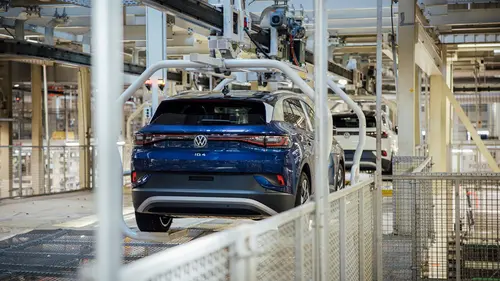
Ambitious fleets targets would also bolster local manufacturing and jobs. 74% of all new corporate EVs registered in the EU in 2025 are already made in Europe [5] and this share is likely to increase further if, as proposed, only EU-produced EVs are eligible for financial support [6]. European carmakers could sell up to 1.9 million additional EVs in 2030 under a more ambitious 69% EV-only fleets target [7]. This is almost four times the annual production of the VW Wolfsburg factory for all powertrains. Keeping the current target for EVs at 45% would cool this effect, generating only a maximum of 1.2 million additional Made-in-EU EVs. The definition of Made-in-EU will be set down in the Industrial Accelerator Act (IAA) later this month.
Sofie Grande y Rodriguez adds: “The EU fleets law is Europe's secret weapon to turbo charge domestic car production. With made-in-EU EVs already being the favourite choice for corporate buyers when going electric, fleet targets will support European car manufacturers and jobs.”
NOTES TO EDITORS
[1] The analysis of ZEV sales required for carmakers to meet their 2030 CO2 targets refers to the Commission’s proposal from December 2025: 55% emissions reduction vs 2021, target averaging 2030-2032, supercredits for small Made-in-EU BEVs, expected improvements in ICE efficiency and hybrid sales, and no UF weakening. Our model uses the share of car registrations by large companies NGC provides for the French market and applies it to the remaining Member States.
[2] Large companies in the proposal are all those that at least meet two of the three following criteria: balance sheet total of €25M, net turnover of €50 million, or more than 250 employees. They make up only 0.16% of all companies operating in the EU.
[3] The European Commission included three scenarios in its Impact Assessment (65%, 70%, 75%). The medium ambition scenario set a 70% EV-only target for large companies.
[4] Dataforce data for 2025.
[5] Here ‘made in Europe’ refers to all vehicles for which the final assembly line is located in the EU-27 (i.e. EVs of European brands that are produced in China and imported into the EU are not counted as Made-in-EU). This share is lower for private EV new car registrations - only 65%.
[6] In Article 4 of the Clean Corporate Vehicles Regulation, the European Commission proposes to end subsidies (financial support) for fossil fuel corporate cars and to make any form of financial support for company cars at national level strictly conditional to vehicles that are “Made in the European Union”.
[7] T&E’s calculations on the number of made-in-EU EVs that the law would deliver assumes all corporate EVs registered by large companies will be Made-in-EU.
Related Articles
View All
Wave of affordable electric cars is boosting consumers' choice: sales of sub-€25,000 models set to rise sevenfold
Electric car choice is expanding rapidly thanks to EU clean car targets, but weakening the 2030-35 targets would put affordable models and Europe’s po...

EV progress report: 'Don't stop me now', the EV transition is delivering
The EU car CO₂ targets are delivering record electric car sales and a wave of affordable models. However, weakening the 2030-2035 target as currently ...
What is the situation with residual values in Europe?
Understanding how Residual Values have evolved and what has driven the change over the last years